
On December 6, 2024, the Hong Kong government officially announced the Stablecoin Bill, marking an important moment for Hong Kong to become a global digital asset center. This long-awaited legislative initiative lays the foundation for comprehensive regulation of stablecoins ( FRS ) anchored to fiat currencies, which not only meets global standards, but also addresses financial stability risks, while promoting innovation in the virtual asset industry.
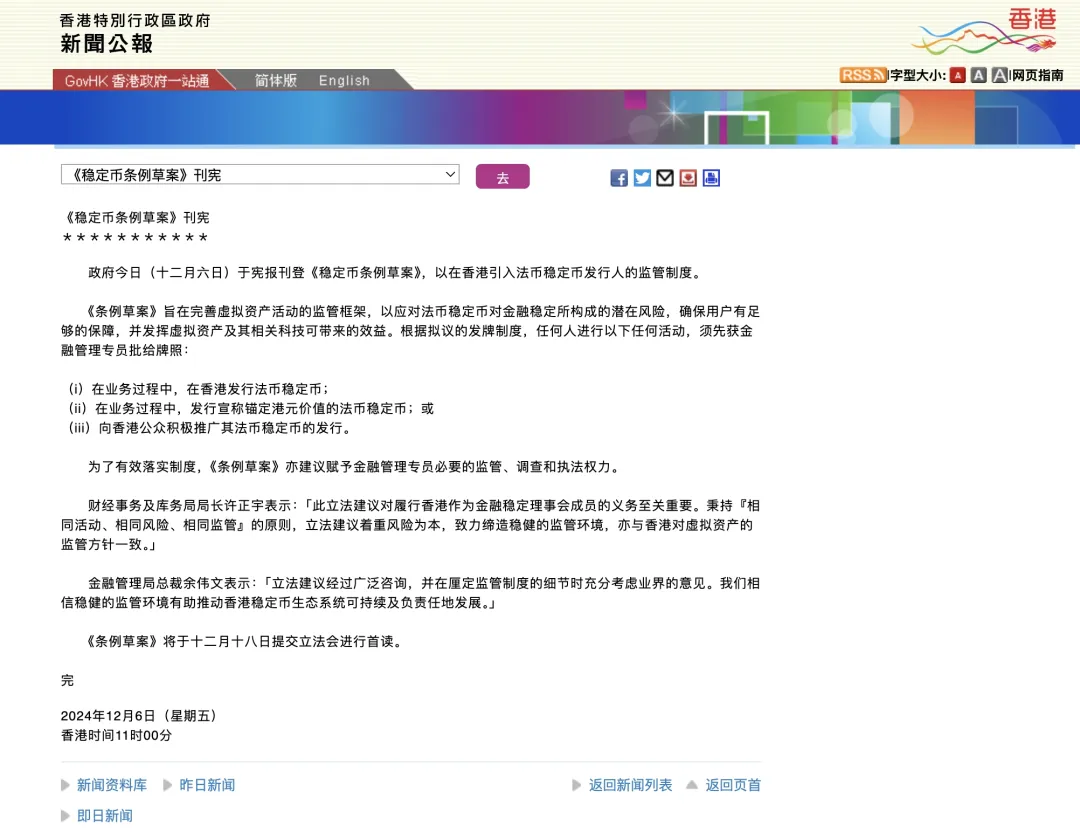
▲Related news screenshots
The proposed framework requires any person or entity to obtain an appropriate licence from the Hong Kong Monetary Authority ( HKMA ) when engaging in the following activities:
1. Issue FRS in the course of business operations in Hong Kong;
2. issuing, in the course of its business, an FRS which purports to be denominated in Hong Kong dollars; or
3. Actively promote the FRS it issues to the Hong Kong public.
The Act also gives the HKMA powers to monitor, investigate and enforce compliance.
A robust approach to stablecoin regulation
The Stablecoin Bill is the result of extensive consultation with industry stakeholders and international best practices. It introduces key requirements for FRS issuers, including:
Licensing: A mandatory licence will be imposed on issuers of FRS operating in Hong Kong or marketing them to the Hong Kong public.
Reserve management: Issuers must maintain high-quality, liquid reserves equivalent to the value of the issued stablecoins.
Capital requirements: The minimum paid-in capital is set at HK$25 million (approximately US$3.2 million) or 1% of the par value of the fiat-pegged stablecoin in circulation.
Risk Mitigation: Obligations include annual risk assessments, AML/CFT compliance and strict redemption policies.
The bill follows the Financial Stability Board’s “same activity, same risk, same regulation” principle, ensuring that FRS issuers meet similar standards as traditional financial institutions.
Comparing Jurisdictions: Global Approaches to Stablecoin Regulation
As stablecoins gain traction around the world, jurisdictions have taken different approaches to regulation. Hong Kong joins the ranks of countries taking concrete steps to regulate stablecoin issuers. Here is a comparison of key jurisdictions in terms of regulatory progress:
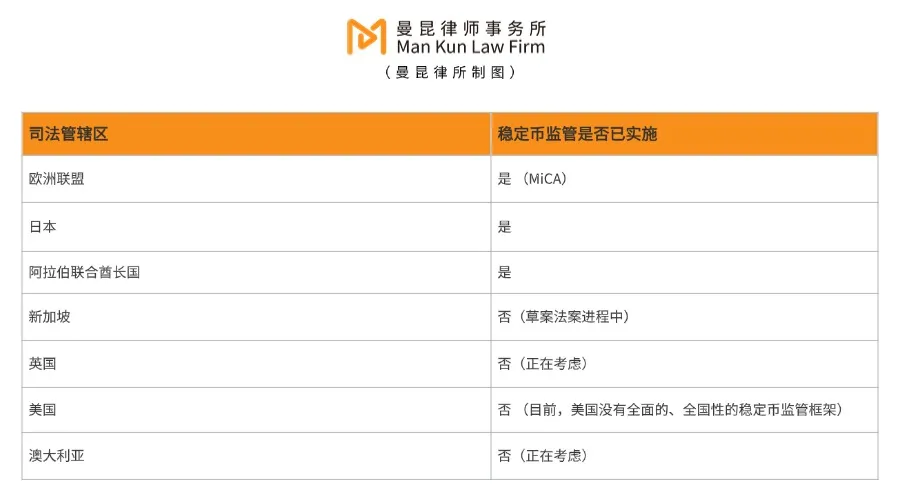
Hong Kong’s proposed regime stands out for its focus on single-currency and multi-currency stablecoins and its inclusion of both decentralized and centralized systems.
From consultation to legislation
The HKMA's discussion paper on crypto assets and stablecoins in 2022 and subsequent consultation papers in 2023 and 2024 marked the beginning of the journey towards the Stablecoin Bill. Recognizing the risks posed by FRS - especially their potential spillover effects between virtual assets and the traditional financial system - Hong Kong has been methodically advancing this legislation. The bill reflects feedback from global regulators and local industry stakeholders and aims to establish Hong Kong as a safe and innovative digital asset environment.
Currently, the HKMA regulates stored value facilities under the Payment Systems and Stored Value Facilities Ordinance, while the Securities and Futures Commission regulates virtual asset service providers under the Anti-Money Laundering and Anti-Terrorist Financing Ordinance. The new legislation will further supplement these frameworks and fill the regulatory gap for stablecoins.
Licensing requirements for Hong Kong’s legal tender reference stablecoins
The licensing framework under the Hong Kong Stablecoin Act sets strict requirements for entities that issue or market FRS. These measures are designed to ensure financial stability, consumer protection and compliance with anti-money laundering and counter-terrorist financing (AML/CFT) standards.
Key license plate standards
1. Reserve Management and Stabilization
Full asset backing: Issuers must maintain reserves equal to or greater than the value of stablecoins in circulation. Algorithmic or arbitrage stablecoins that lack reserve backing are prohibited.
High-quality investments: Reserve assets must be liquid, low-risk, and diversified, including cash, deposits at licensed banks, government-backed securities, and similar instruments.
Segregation of reserves: Reserves must be held in separate accounts with approved custodians and protected through trust arrangements.
2. Redemption policy
Under normal circumstances, the issuer must guarantee to redeem the stablecoin at face value within one day to ensure user liquidity.
3. Governance and local presence
The issuer is incorporated in Hong Kong and has offices and senior management in Hong Kong to enable effective supervision by the HKMA.
4. Financial resources and risk management
The issuer ’s minimum capital requirement is HK$25 million or 1% of the stablecoins in circulation, whichever is higher.
Regular risk assessments, stress testing and comprehensive liquidity management practices are mandatory to address operational and financial risks.
5. Transparency and Disclosure
Stablecoin circulation, reserve composition, and independent audits must be disclosed regularly.
License applications must be accompanied by a white paper detailing the stablecoin’s governance, risks, and operational framework, which must be available for public inspection.
6.AML/CFT Compliance
Issuers must implement strict AML/CFT measures, including customer due diligence, transaction monitoring and compliance with the Anti-Money Laundering and Counter-Terrorist Financing Regulations.
7. Restrictions on business activities
Issuers are prohibited from engaging in high-risk financial activities such as lending or financial intermediation, and must seek HKMA approval for any new business lines.
Looking ahead
The Stablecoin Bill will be read for the first time in the Legislative Council on December 18, 2024, the next step in its journey to become law. Once implemented, Hong Kong will join the ranks of global stablecoin regulatory leaders, reinforcing its commitment to financial innovation and stability. As the global stablecoin ecosystem evolves, Hong Kong's proactive regulatory stance may serve as a model for other jurisdictions to ensure that stablecoins live up to their promise as safe, efficient and inclusive financial instruments.