
By|Sleepy
On June 17, SK Hynix posted a recruitment notice. For core technical positions in chip design, devices, and R&D, which previously required at least a bachelor's degree, all academic requirements were removed starting that day. High school graduates who want to do R&D are welcome. This round of hiring targets over a hundred people, with a deadline of June 23. The company also said it will adjust the academic restrictions for production positions later.
In a country where society spent seventy years betting its fate on the word "diploma," the number one company has declared that diplomas are useless.
According to the Korea Herald, this company ranked first for the first time in 2025 among the most desired employers for South Korean university students.
The reason is simple: SK Hynix pays extremely well. Last September, they signed an agreement with the labor union to allocate 10% of annual operating profit as bonuses, with no cap. In 2025, with a profit of 47 trillion won, year-end bonuses reached 2,964% of monthly salary, meaning an ordinary employee took home roughly 700,000 RMB. In the first quarter of 2026, the profit margin was 72%, even higher than Nvidia's. If this momentum continues for the full year, per capita bonuses could potentially exceed 3 million RMB.
The status of SK Hynix employees in South Korea's matchmaking market now rivals that of traditionally high-income professions like doctors and lawyers. Matchmaking agency staff told the media that since the semiconductor super cycle began, engineers whose incomes far exceed expectations have become more popular than lawyers.
The Korea Herald reported a detail. On the second-hand platform Karrot, someone listed an SK Hynix union vest for 40,000 won, with a four-word product description: matchmaking battle gear. The post quickly became a trending topic.
There's a widely circulated joke. When SK Hynix employees go on blind dates, they humbly say they work at Samsung. Only when they meet someone with a good character do they confess they actually work at Hynix.
Samsung is really bleeding. At least 200 engineers have jumped ship to Hynix in four months. Those who left say their income tripled and a half. The Samsung union leader looked grim when revealing this number to reporters, because Samsung can't match that price. Samsung's size is too large; in the same quarter that semiconductors were wildly profitable, mobile phones and home appliances were still losing money.
When SK Hynix announced the removal of academic barriers, it gave a rationale. It said that in the AI era, you can't just look at diplomas; you have to look at creativity and potential. SK Group Chairman Chey Tae-won mentioned three words: thinking ability, adaptability, and empathy.
All fine words.
A Single-Plank Bridge Built Over Seventy Years
South Korea is the country that has taken the concept of "diploma" to the most extreme level in the world. The OECD has calculated that 71% of South Koreans aged 25 to 34 have a university degree, the highest rate globally. On the day of the college entrance exam, flight paths are adjusted, the stock market delays its opening, and police cars are responsible for escorting late students. It's not because South Koreans have an extraordinary reverence for knowledge, but because a university admission letter in South Korea is practically a visa—a visa from the bottom to the middle class.
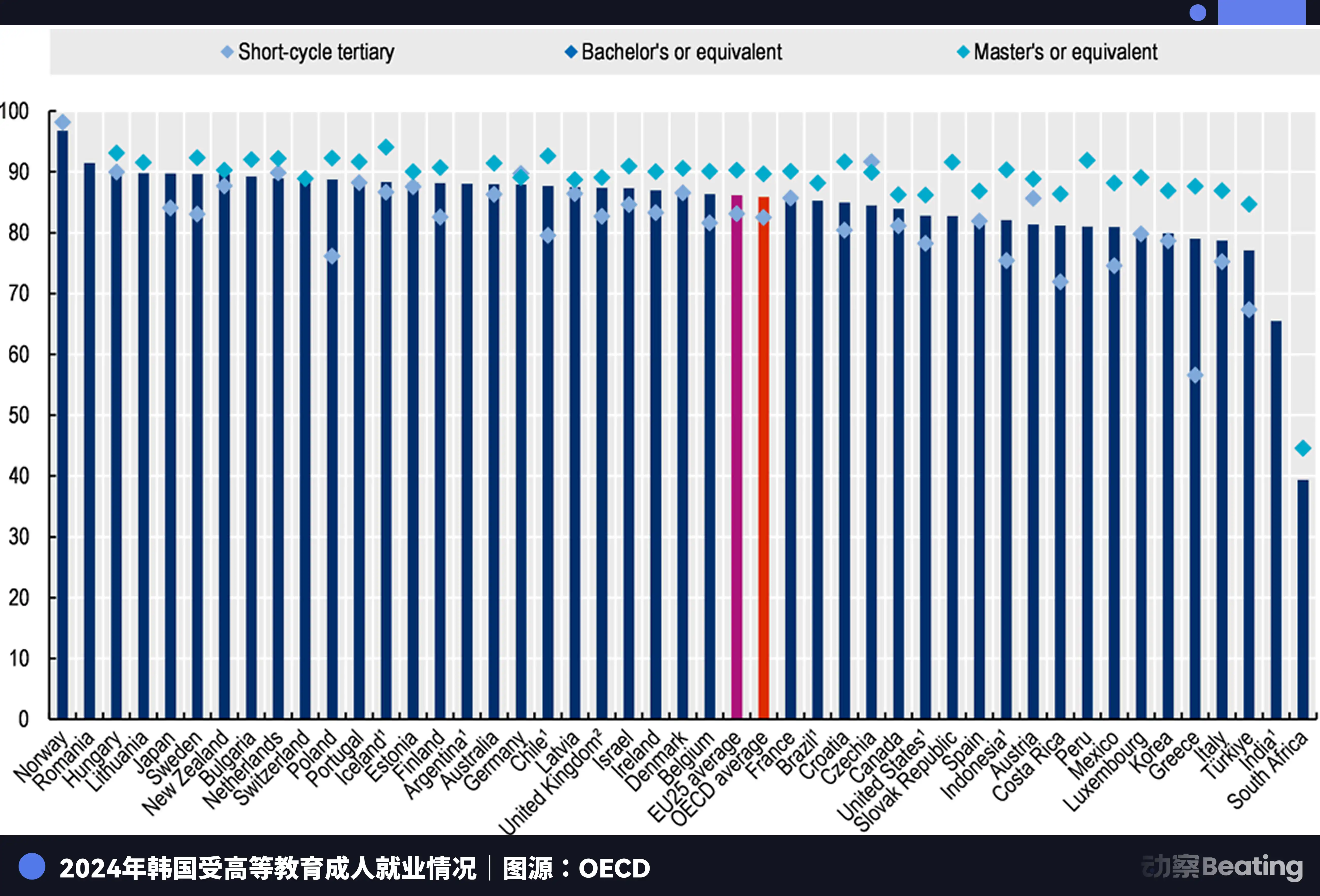
Without it, you can't go anywhere. With it, at least you can stand in line.
To understand how this visa became so important, you have to look back sixty or seventy years.
During the Park Chung-hee era, South Korea tied its entire economic lifeline to a few large chaebols. Samsung, Hyundai, LG, SK—they occupied the most profitable businesses, offered the highest wages, and held the most stable iron rice bowls. The salaries that small and medium-sized enterprises (SMEs) could pay were about 60% of those at the chaebols. 81% of the labor force worked in SMEs, but everyone's eyes were fixed on the less than 1% of job openings at the chaebols. In South Korea, a graduate's first job essentially determines their lifetime income.
What does it take to get into a chaebol? A university diploma, a diploma from a good university.
Families across the entire country began to crowd onto this single path. The Bank of Korea conducted research showing that for students of similar aptitude, the influence of parents' economic power on the probability of admission to a prestigious university is as high as 75%. One-third of Seoul National University freshmen come from Seoul, with the three Gangnam districts alone accounting for 12%.
South Korean young people created a self-deprecating term called the "Spoon Theory." Those with family assets over 2 billion won are called "gold spoons," and those under 50 million won are "dirt spoons." Seventy to eighty percent of South Koreans feel that upward class mobility has nothing to do with them anymore.
Someone wrote online about their family situation. The gist was: My mom ran a small restaurant, working without a single day off for ten years, and saved enough for my university tuition. I went to an obscure university in another province, studying liberal arts. Now I'm serving plates at a café, earning 1.8 million won a month. My younger sister is about to graduate high school, and I told her not to go to university, to learn a trade instead. But my mom disagreed. She said, it's precisely because we have no education that we live like this.
In small towns across South Korea, families like this are everywhere.
In the small towns of Chungcheong, Gyeongsang, and Jeolla provinces, the lights of cram schools stay on until 11 p.m. Outside, the streets are empty; even the convenience store clerks are dozing off. Sixteen or seventeen-year-old kids walk home, their entire understanding of Seoul coming from a phone screen. Parents send hundreds of thousands of won to cram schools every month; for families running small restaurants or fried chicken shops, this is flesh cut off piece by piece. But they still send it, because without it, their children don't even have the qualification to line up on the single-plank bridge.
South Koreans use the term "Fried Chicken Conjecture" to mock themselves. No matter what you do now—programmer, architect, engineer—you'll most likely end up as the owner of a fried chicken shop. Because there are only so many spots at the chaebols, and those who can't get in will eventually fall, falling to the same place. Small-town youth resonate most with this conjecture because they are farthest from those spots and fall the fastest.
Someone once said that living in Seoul is every hell he could imagine. But what about not going to Seoul? The local job market is even quieter than hell. So quiet that even hell would find it desolate.
So they still went. Squeezed into Seoul, moved into a goshiwon, a room barely larger than a bed, with partitions so thin you can hear the person next door turn over, and a shared bathroom at the end of the hall. During the day, they attend classes or prepare for interviews; at night, they memorize TOEIC vocabulary under a desk lamp. Young people in their early twenties live in a four-square-meter cubicle, all to save up enough for a ticket as a "large corporation job applicant." Diploma, English scores, certifications, internship experience, volunteer activities—South Koreans call this whole set of things "spec," exactly like adding attribute points to a game character, each item requiring time and money to grind.
In the 70s and 80s, mom was right. Back then, the whole society was like an elevator, and a diploma was the ticket; if you bought it, you went up with it.
The elevator has been stopped for a long time.
When 71% of young people hold a university diploma, the diploma no longer proves you're capable; it only proves you haven't fallen to the very bottom. If everyone has it, it's almost as if no one has it. What really filters people are the add-ons that have grown on top of the diploma. Overseas exchange experience, extracurricular competitions, personal connections for referrals, interview training courses. Each one requires money to buy.
The single-plank bridge has reached a point where the children are walking on the bridge surface, but what supports the bridge underneath is the family's wealth.
The Bridge Breaker Stands at the Other End
SK Hynix says, you don't need to cross the bridge anymore. High school graduates can come do chip R&D. They look at ability, not paper.
I tried to think about this from another angle.
If they're not looking at diplomas, what are they looking at? The company mentioned a few words: growth potential, creative problem-solving skills, cultural fit.
College entrance exam scores are black and white, a single national standard. You can question how crude this standard is, but you can't deny it. "Growth potential" is not that kind of thing. Its shape is determined by the interviewer. "Cultural fit" is even more nebulous; it can be almost anything, or nothing at all.
A small-town high school graduate sits down at the interview table at SK Hynix's Icheon campus. He grew up in a small town in North Gyeongsang Province, a three-hour drive from Seoul. His high school had no semiconductor lab, no programming club, and the books about chips in the library might have been published a decade ago. He's smart, but no one ever showed him what a wafer looks like.
Now, the person across from him has to judge within an hour whether he has "flexible thinking." This judgment relies on the way he speaks, his posture when thinking about problems, and a certain temperament revealed in conversation. These things are related to talent, but to a greater extent, they depend on the kind of environment a person grew up in, what books they've read, what people they've met, what places they've been to, and whether anyone taught them how to articulate their thoughts clearly in front of strangers.
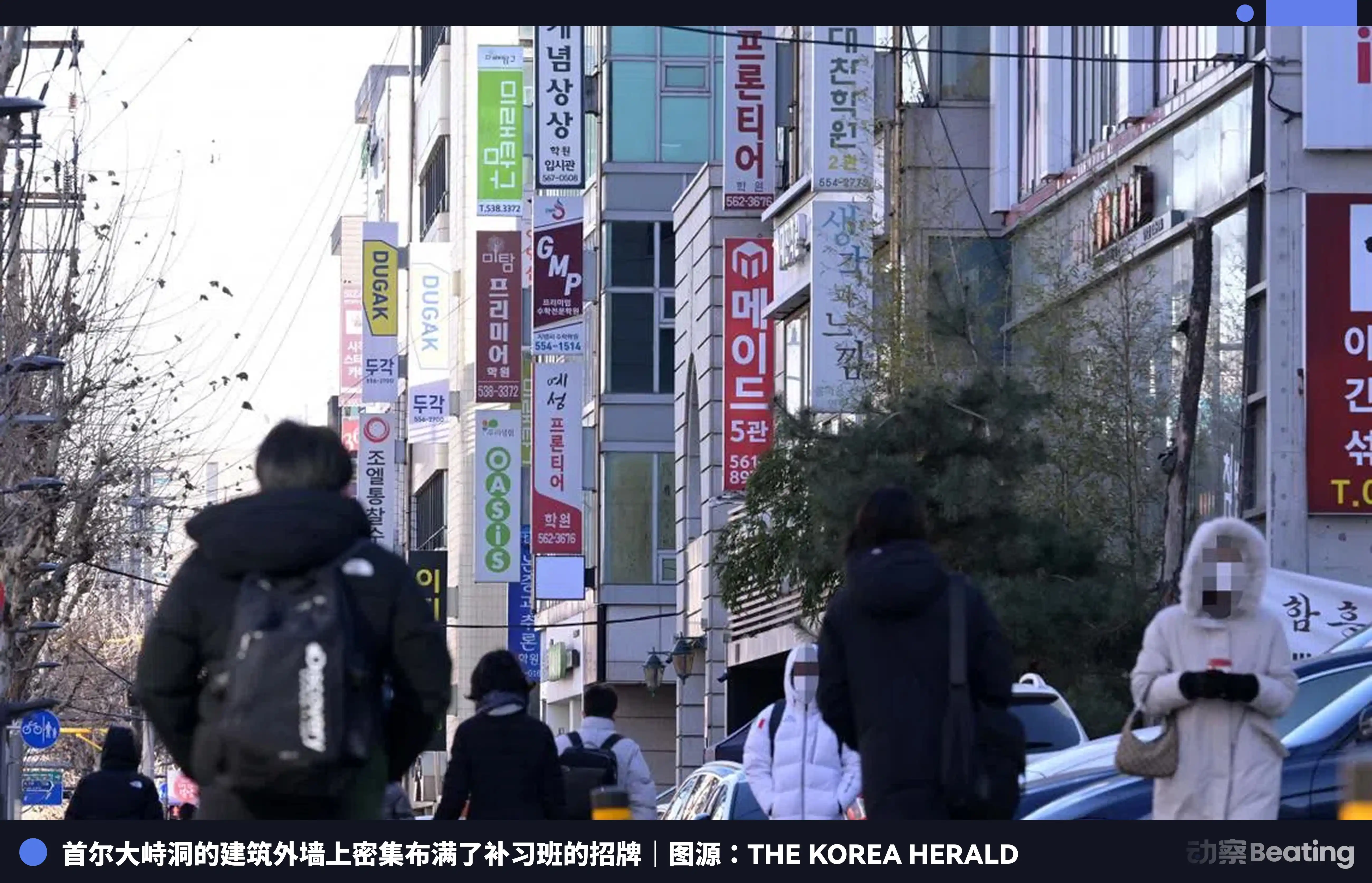
And the interview prep academies in Daechi-dong, Gangnam-gu, won't close down; they'll just switch to a new curriculum. Business won't be affected; it might even get better.
The old rules were hard, but transparent. If you got the score, you got in; no one dared to reject you to your face without a reason. The new rules are soft, respectable, and full of goodwill. But the softer the ruler, the easier it is to bend, and which way it bends depends on whose hand is holding it.
That mother who ran a restaurant for ten years to put her daughter through university. She only had one card in her hand, and that was the diploma. Not because that piece of paper has any magical power. But because in this card game, this was the only one she could afford.
Kids from Gangnam don't rely on this card. They learn programming from elementary school, go to Silicon Valley for summer vacations, and have extracurricular activity lists that fill three pages. A diploma or not doesn't matter. The same card is a person's entire life savings for one type of person, and a dispensable decoration for another.
The card game changed its rules, and the first card removed from the table just happens to be the only one the poor had.
The New Single-Plank Bridge
Looking solely at recruitment efficiency, SK Hynix's removal of academic requirements is a good thing. They are in the best year of the company's history, with HBM orders booked two years out, and they urgently need people who can work. If a high school graduate can really do chip design, there's no reason for that barrier to stand in their way.
But SK Hynix is the number one choice for South Korean university students. When it says diplomas don't matter, these words will travel through campus walls and into every cram school. Every high school student still doing practice problems under the lamp will waver for a second.
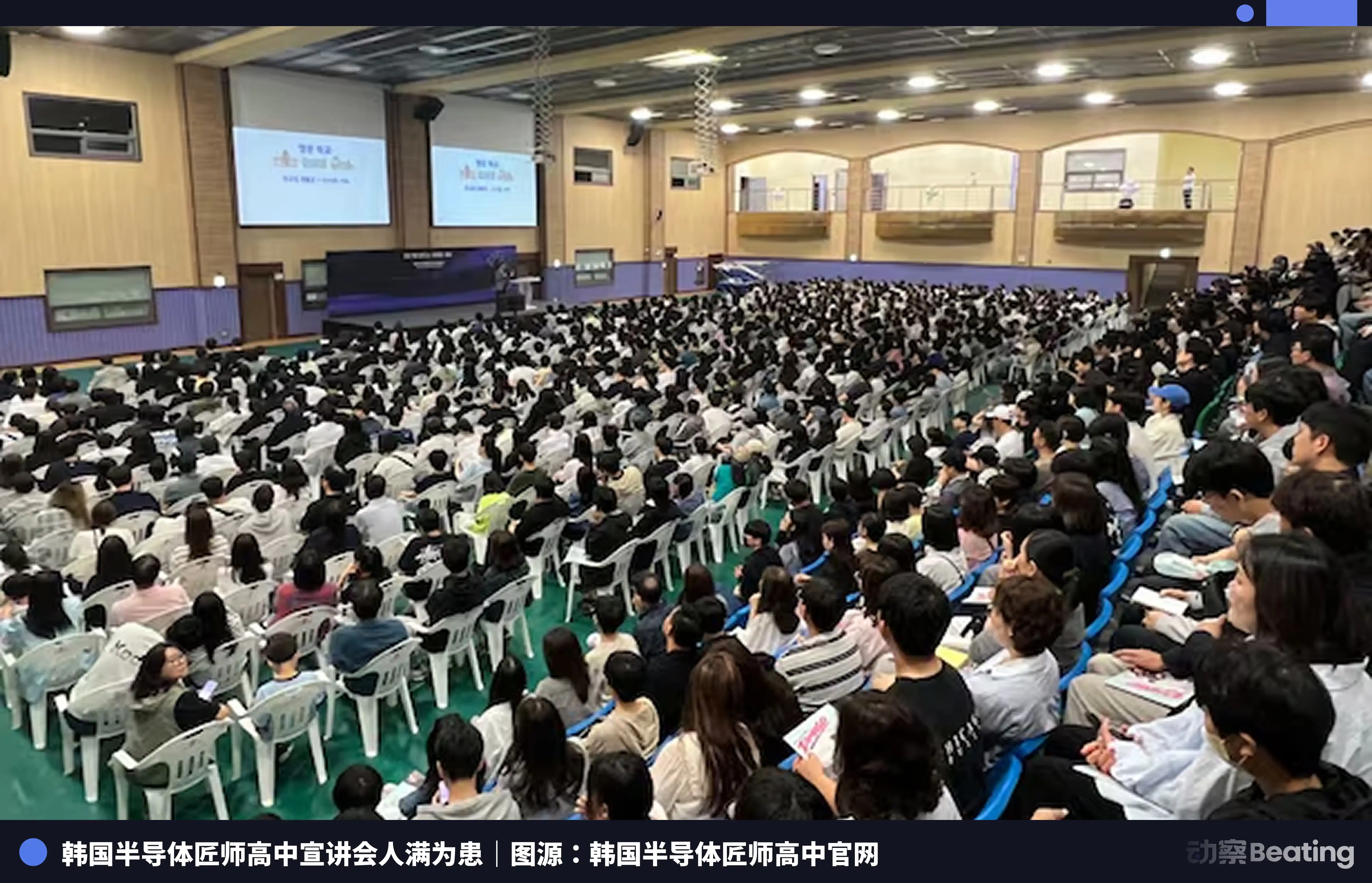
South Korea already has semiconductor vocational high schools. One called "Korea Semiconductor Meister High School" recently held its first admissions briefing, and it was packed. After three years of study, graduates step onto Hynix's production lines and can earn in a year what their fathers might earn in a lifetime.
In the same month, data from Statistics Korea showed that employment in May decreased by 40,000 year-on-year, the first negative growth in seventeen months. Manufacturing employment has declined for twenty-three consecutive months. Only semiconductors are rising; all other industries are falling.
A new single-plank bridge has been built. Only this time, the other end of the bridge isn't a university; it's a company.
No matter how competitive universities are, there are at least hundreds to choose from, with thousands of majors, and the directions are still diverse. If the entire bet of the next generation of South Korean youth changes from "getting into a good university" to "getting into a good company," they are still gambling, just with a different house.
Hynix says it no longer looks at academic qualifications, while 40,000 people at Samsung are on strike demanding a share of the profits. These two things pieced together form one single story. It's not some self-reform of the academic system. It's that the money is too powerful, so powerful that any system standing in the way of profit has to step aside. Rules follow the money.
That river has always been there. Over the decades, the bridges built over it have changed several times. Imperial examinations, college entrance exams, university diplomas, and this time, "comprehensive quality assessment."
That river is the 60% wage gap between chaebols and small companies, the resource disparity between Seoul and the provinces that spans an entire world, the line between the gold spoon and the dirt spoon, welded shut at birth.
In "JR Ueno Station Park Exit," Yu Miri wrote about a man. He came to Tokyo from rural Fukushima to build the venues for the 1964 Olympics. He did manual labor, sent money home, didn't complain, didn't stop, and did everything he was asked to do. When the venues were finished, Tokyo no longer needed him, and he ended up sleeping on a bench in Ueno Park, right next to the stadium where he had once laid bricks. People came to stroll, people came to take photos. No one saw him.
He didn't do anything wrong. It's just that the things he did were no longer needed the day they were finished.
When I read this book, I kept thinking about that mother who ran the small restaurant. She must have seen the SK Hynix news today.
I guess she won't change her mind; her younger daughter will still go to university.
Not because she doesn't understand. But because she understands, yet dares not accept it. If she accepts it, the past ten years were for nothing. All those days without a single day off, those days of splitting every single won of gross profit in half, those days when she refused to close the shop even with a fever—all of it was so her daughter could get that piece of paper. If that paper really doesn't matter anymore, then what were all those things she did?
So she will continue to support, continue to save, continue to send money to the cram school. That four-square-meter cubicle in the goshiwon—her younger daughter will eventually move in there too.