
Written by: Jaleel, BlockBeats
On June 17, Polymarket celebrated its sixth anniversary since launch.
In the crypto world, six years is already a long time. Long enough for a narrative to go from bubble to ruins, and long enough for a product to go from a fringe experiment to mainstream infrastructure. Six years ago, Polymarket was just a prediction market built by a young founder in his bathroom during New York's COVID lockdown. Six years later, it has entered Google, WSJ, sports leagues, the CFTC regulatory framework, and the balance sheet of NYSE parent company ICE, becoming the world's most watched "information market."
If you only look at today, Polymarket seems like a typical success story: trading volume exploding, valuation soaring, founder joining the ranks of the youngest self-made billionaires, prediction markets moving from a small crypto circle into mainstream media and sports broadcasts. But if you pull the timeline back, this story is not smooth. It is not a product history of linear growth, but an adventure of constantly being kicked out and constantly trying to come back through the front door.
Polymarket's earliest proposition was simple: when the world is full of uncertainty, can prices get closer to the truth faster than media, experts, and polls? COVID, the US election, the Titan submersible, Biden's withdrawal, the Trump Whale, the FBI raid, CFTC approval, ICE investment—over these six years, it repeatedly turned real-world events into markets, and was repeatedly bitten back by the rules of the real world.
So, the significance of Polymarket's sixth anniversary is that it's time to witness how a crypto product born in a bathroom came to stand at the intersection of finance, media, sports, and regulation. What this BlockBeats article wants to tell is exactly these six years of Polymarket: how it survived, how it was kicked out of the US, and how it bought its ticket back home.
The Gambler in the Bathroom
In October 2013, an email landed in the inbox of the U.S. Securities and Exchange Commission.
The sender was Shayne Coplan, 14 years old, still in high school in Manhattan. According to the version he later shared, this email came from a teenager fascinated by electronic trading networks after reading "Flash Boys." The email body was short, but the tone had a unique mixture characteristic of youth: half naivety, half confidence.
He first introduced himself, saying he was a sophomore in a Manhattan high school, working on an ECN-based stock exchange, and that his first priority was to confirm this idea was "completely legal" and could meet SEC regulatory requirements.

Shayne Coplan
On December 2, 2024, Coplan posted this old email on X with a single caption: "What people call an 'overnight success' takes a decade." Looking back over a decade later, this email seems like an overly neat foreshadowing. Of course, Coplan didn't know then that what he would actually build wouldn't be a traditional stock exchange, but a prediction market where the whole world bets on the future with prices. Nor did he know that this market would later be kicked out of the US due to regulatory issues, only to try and walk back through the front door years later.
Polymarket's Prehistoric Story
Coplan grew up in Manhattan, raised by his mother; his father was an NYU film professor. He attended a public school in Hell's Kitchen, not an elite prep school for Wall Street offspring. The impression he later gave was not of someone trained in the traditional financial system. He was more like a kid who grew up out of internet culture, cryptocurrency, startup biographies, and the streets of New York.

Coplan credited his high school graduation to "cram notes, caffeine, and Wikipedia." Photo: Shayne Coplan/Facebook
In those years, he began to encounter cryptocurrency. According to media reports, the entry point even carried a bit of early internet serendipity: while downloading pirated music, he stumbled upon crypto, then started researching it, even trying to assemble his own mining rigs. For many peers, the internet was games, music, and social platforms; for Coplan, it was more like a staircase leading directly into the basement. Following this staircase, he saw a new financial world without teachers, entry tickets, or age limits.
In 2014, the Ethereum presale began. Coplan bought ETH at a price of about $0.30 per coin. This early investment later became his startup seed capital.
During the same period, he went to the lyrics website Genius to volunteer his services. He sent many emails with no response, so he just showed up at the office door. NYMag later described the young Coplan as having a mop of curly hair and an almost encyclopedic knowledge of billionaire tech entrepreneurs. Genius eventually gave him an internship.
This experience is important to the Polymarket story because it shows that Coplan's early study wasn't finance, but "how a person turns an internet idea into reality." He annotated pages for Zuckerberg, Travis Kalanick, and others on Genius, as if drawing a blueprint for his own future path. A teenager repeatedly reading these people's stories, parsing them over and over, was essentially learning a path: how a fringe idea enters the mainstream world.
Later, he entered NYU to study computer science but dropped out after just one semester to dive full-time into crypto entrepreneurship. Between 2018 and 2019, he bought the union.market domain and created a product called Union Market, aimed at yield-generating digital assets. This project didn't really take off.
But failure didn't make him leave the "market" problem. During that time, he read economist Robin Hanson's paper on futarchy. The core idea of futarchy was radical: if markets can aggregate information, could prediction markets help society make decisions? In other words, could prices reflect not just asset value, but also the probability of future events?
Coplan wrote to Hanson, saying he wanted to build a prediction market. Hanson didn't take it too seriously. The reason wasn't complicated: prediction markets weren't a new concept; there had been too many attempts over the decades, with far more failures than successes. This field always sounded perfectly correct, yet it was always very difficult to truly enter public life.
By the end of 2019, Coplan was once completely disillusioned with crypto. He was 21, had been out of school for two and a half years, hadn't produced a big enough result, and was almost out of money. Looking back at Polymarket's birth later, it's easy to tell it as a "genius founder spots an opportunity" story. But on the real timeline, it was more like someone at a low point, continuing to search for an exit within an old idea.
What truly changed everything was 2020.
COVID Breaks the Routine
In March 2020, New York became the epicenter of the US COVID-19 pandemic.
Times Square was empty, Broadway was closed, restaurants had chairs flipped upside down on tables, and subway cars held only a scattered few masked people. The sound of ambulances became the city's background noise. Every morning, the first thing people did upon waking wasn't checking the weather, but looking at new case numbers, hospitalizations, deaths, the governor's briefings, and new lockdown rules.
For the vast majority of New Yorkers, lockdown meant fear, stagnation, and endless waiting. Some lost jobs, some left the city, some were trapped in tiny apartments refreshing the news repeatedly.
Everyone was asking the same kind of questions: When will the lockdown end? Will cases keep rising? When will a vaccine arrive? Will the presidential election be rewritten by the pandemic? But the answers from traditional information channels were unstable. Experts, media, government, social platforms—every voice seemed certain, and every certainty was quickly overturned by new reality.
This was precisely the environment prediction markets needed most. Not because people suddenly liked to gamble, but because life had too many unavoidable and unpredictable real-world questions. The pandemic turned "the future" from an abstract concept into something everyone had to face daily. Everyone was predicting, it's just that most predictions had no price.
Coplan saw this opportunity.
He developed the product in the bathroom of his Lower East Side apartment in New York. He later repeatedly referred to it as his "makeshift bathroom office."
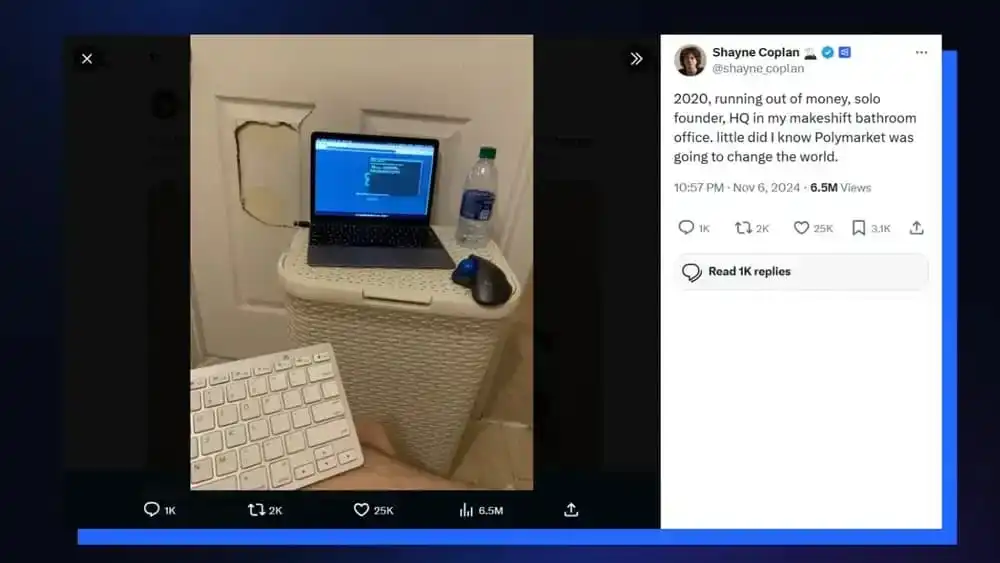
A young man with almost no resources, at the world's most chaotic time, trying to build a market that priced chaos. The pandemic turned everyone into a predictor, and what Coplan wanted to do was compress these judgments scattered across chat groups, news comment sections, expert interviews, and traders' desktops into a tradable price.
He had no co-founder, was almost out of money, and needed to inventory items in his apartment to figure out what he could sell to pay rent. The product name was still changing: Union.market, Union Marketplace, finally becoming Polymarket. This name later sounded like a given, but at the very beginning, it was just a new entrance growing out of the wreckage of an old project.

Polymarket founder Shayne Coplan, Image source: CBS "60 Minutes"
In June 2020, Polymarket officially launched. Technically, it used Polygon and USDC for settlement, offering lower fees, faster speed, and a user experience closer to a regular internet product compared to early Ethereum mainnet prediction markets like Augur.
The early markets were very direct: ETH price, US COVID-19 case trends, the 2020 election. These markets seemed scattered, but they collectively pointed to the same question: when the world is surrounded by uncertainty, are people willing to express their judgment about the future with real money?
Four months later, the answer began to emerge.
In October 2020, the US presidential election entered its final sprint. The pandemic wasn't over, mail-in ballots became a new battleground, the aftershocks of racial protests still echoed in the streets and TV debates, and the shadow of economic recession weighed on household bills and market expectations. Trump tried to prove he could lead America out of the crisis, while Biden framed the election as a chance to "return to normal."
That autumn, every part of American society was being pulled by politics. TV stations scrolled polls daily, hosts repeatedly deduced scenarios on red and blue maps; social media was full of conspiracy theories, camp mobilization, and arguments over mail-in ballots; Wall Street tried to judge the direction of taxes, regulation, and fiscal policy; ordinary people searched for a bit of certainty between the pandemic and the election. Everyone was asking: Does Trump still have a chance? How solid is Biden's lead? If the count is delayed, will the market crash first?
When Polymarket launched, it was still a niche crypto tool, but the election gave it its first real public test. In October, Polymarket completed a $4 million seed funding round led by Polychain Capital, with participation from Naval Ravikant, 1confirmation's Nick Tomaino, and others.
For a product just made in a bathroom, this money wasn't just capital; it was more like a signal: at least a group of crypto investors believed prediction markets could become useful again.
In November, the Biden vs. Trump showdown entered its final moments. Polymarket's market prices consistently pointed to a Biden victory in the weeks before the election. The "Will Trump win?" market saw trading volume exceed $8 million. Looking back today, $8 million isn't large, nowhere near the billions seen during the 2024 election. But at the time, it was enough to prove one thing: people were willing to put political judgments into on-chain markets for trading.
This $8 million wasn't the end point of a commercial success, but the beginning of a product proposition. It proved that Polymarket wasn't just a temporary toy during the pandemic, nor just a self-entertaining experiment within the crypto circle. It gave the question "Can market prices become a real-time signal for public events?" its first visible sample.
Of course, Polymarket in 2020 was still very small. It was more like a tool for a small crypto circle, not a reference source for mainstream political media. Coplan was still running the social media accounts himself, DMing investors one by one, hoping they would help retweet and like. Vitalik Buterin tried Polymarket around the same time and praised its UX on Twitter as friendly for non-crypto users. This evaluation was important, because one of the biggest past failures of prediction markets was that the concept was beautiful, but the product was too hard to use.
Rapped by Regulators
In 2021, Polymarket grew from a personal project into a company of over a dozen people. Users grew from thousands to tens of thousands of MAU. A more complete team began to revolve around it: some focused on product, some on markets, some on community, some on handling the constantly emerging settlement disputes. It was no longer just a page Coplan built alone in his bathroom, but a trading venue genuinely producing prices, controversies, and news material.
The internal team culture was very "rebel/maverick," carrying the typical temperament of a crypto startup: build the thing first, let the market run, then deal with rules and boundaries.
That was the 2021 crypto bull market, where almost everyone believed speed was more important than order. DeFi, NFTs, DAOs, blockchain gaming—every day brought a new narrative, and every new narrative challenged old rules. Polymarket was also in this atmosphere.
Coplan was also continuing to accumulate social capital within crypto culture. Under the identity ethsquiat, he collected NFTs heavily, early supporting crypto artists like FEWOCiOUS. This wasn't Polymarket's main product line, but it's useful for understanding Coplan. After all, for this generation of entrepreneurs, identity, capital, taste, and product are often intertwined; a wallet address can sometimes say more about who you are than a business card. [[HTML_TAG_119]]
But Polymarket is different from most crypto products. NFTs can be described as art, DeFi as financial experiments, and DAOs as organizational innovation. But once a prediction market starts handling real-world events, it directly encounters financial regulation and its boundaries. Polymarket can call itself an information market, but regulators see something else: users betting money on event outcomes, which looks like unregistered event contract trading.
So the CFTC's questions began to become specific. The issue was no longer "Is your product interesting?" but "Are you qualified to offer these contracts?" The more markets on Polymarket, the sharper the questions became. ETH prices, COVID cases, presidential elections, policy events—these markets are information in the eyes of users, but in regulatory filings, they could be binary options.
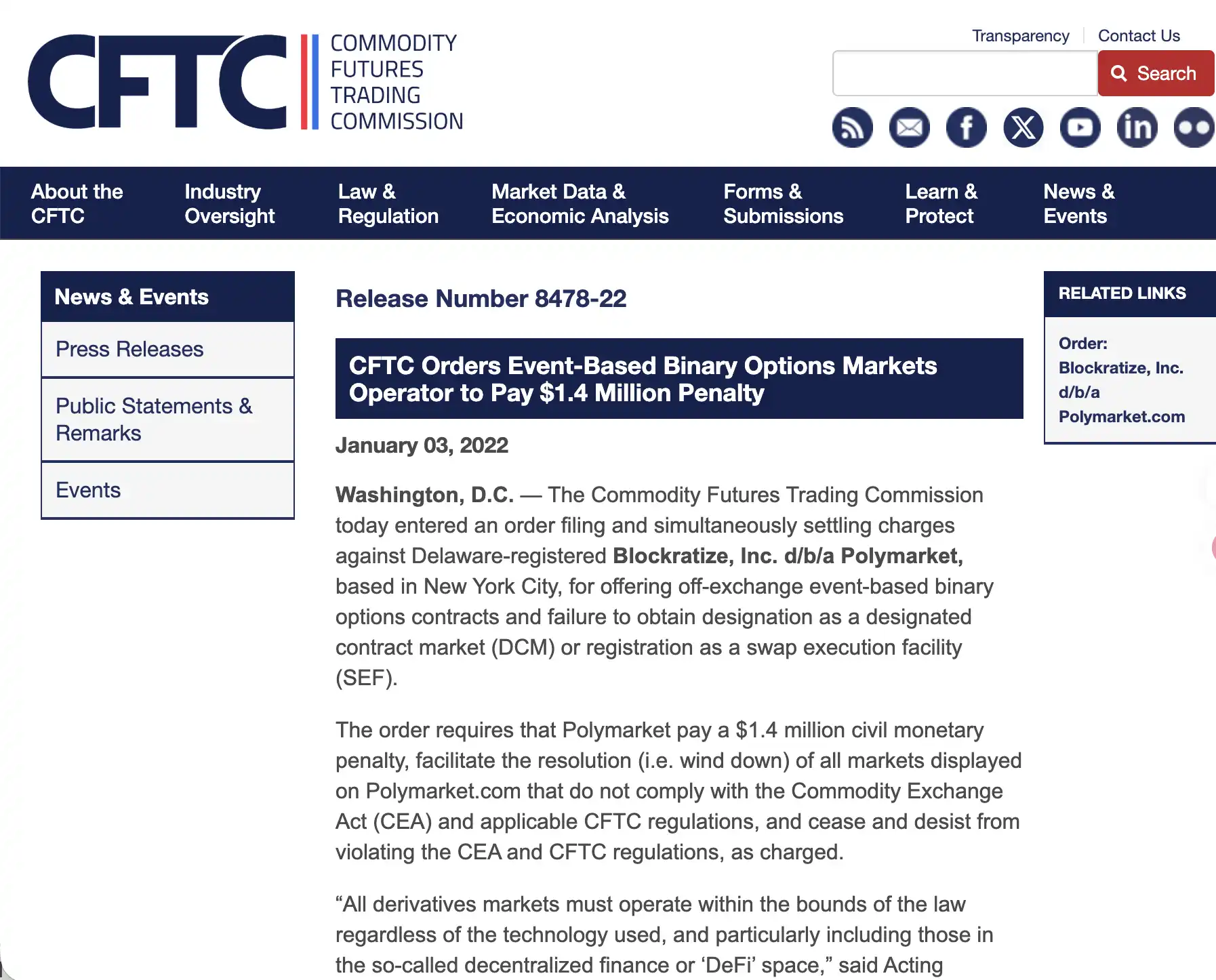
On January 3, 2022, the CFTC issued a cease-and-desist order against Polymarket, alleging that Polymarket operated unregistered event-based binary options markets, specifically off-exchange binary options contracts not offered on a designated contract market. The penalties included a $1.4 million civil monetary penalty, a requirement to wind down non-compliant markets, and a cessation of violations. The CFTC also noted that Polymarket received a reduced penalty due to substantial cooperation. As of that time, Polymarket had already offered over 900 event markets.
After the penalty, Polymarket began geoblocking US users.
A platform still operating from New York, still run by American founders, still serving global political and financial events, was forced to shift its core trading outside the US, even though many of the events discussed on the platform still occurred in the US.
Exile and Explosion
After being penalized by the CFTC, Polymarket entered a very strange state. It wasn't dead, but it was no longer whole. It was still running, still serving overseas users, still able to list various markets, but it had lost its most critical and symbolic home market.
For a New York company, this state was awkward. It wasn't a complete failure, because the product was still alive; nor was it a true success, because American users were locked out. It was more like a kind of exile: the company's people were in America, but the product had to pretend America didn't exist.
In May 2022, former CFTC Chairman J. Christopher Giancarlo joined Polymarket's advisory board and served as its chairman. Giancarlo is known in the crypto world as "CryptoDad," and the signal of this appointment was clear: after being struck by regulators, Polymarket began to build a compliance narrative.
But a compliance narrative couldn't change the situation immediately. An advisory board is not a license, and a former regulator's name cannot automatically open the US market. From 2022 to 2023, Polymarket entered a low tide. The platform operated purely overseas, and its scale shrank. By the end of 2023, the cumulative total trading volume was about $73 million. This number was still mentionable at the time, but compared to the explosion of the 2024 election cycle later, it almost seemed like a different era.
The low tide period is the hardest to write about and the easiest to overlook, because it has no photo that can be repeatedly cited, no tweet that can become a headline, and none of the drama of a regulatory raid. But for a startup, it is often this kind of time that truly determines its fate: no applause, growth not fast enough, the external narrative cooling off, while the team still has to fix the product daily, manage markets, explain settlements, and maintain liquidity.
Coplan did not give up. The team continued to iterate on the product, improving the mobile experience, making pages lighter, making order placement smoother, and reducing the probability of non-crypto users being scared off by wallets, gas fees, and on-chain confirmations. The concept of a prediction market can be grand, but users often leave for a very small reason: loading too slowly, unclear settlement, vaguely written market questions, poor usability on mobile. From 2022 to 2023, Polymarket continued to survive on these small details.
It was also waiting for the next public event to bring people back to prediction markets. Not all waiting feels heroic. Sometimes, so-called persistence is just continuing to maintain a fringe product until the next news cycle arrives, when no one thinks you will win.
The Titan Submersible Incident
That news cycle arrived in an unseemly way.
In June 2023, OceanGate's Titan submersible lost contact en route to the wreckage of the Titanic. Global media began continuous coverage of the rescue efforts. There were search and rescue ships on the surface, experts on news channels explaining the remaining oxygen time, and social media filled with fear, morbid curiosity, anger, and dark humor. With each passing hour, the event looked more like a public tragedy impossible to look away from.

OceanGate used its vessel "Titan" to take tourists deep below the ocean surface to visit the Titanic wreck site, after which the vessel was lost
Polymarket quickly listed a related market, asking "Will the submersible be found by June 23?" The betting volume exceeded $2 million. Polymarket's official account also replied to musician Rico Nasty's viral tweet: "Still a 15% chance they find them by Friday."
This sentence suddenly put Polymarket in the spotlight, but in an unflattering way. Critics saw it as betting on human tragedy, turning death and rescue into a set of odds. Supporters would argue that the market didn't create the tragedy, it just made explicit the judgments people were already discussing. Neither side was entirely without reason.
Subsequently, the US Coast Guard announced the discovery of debris, concluding the submersible had suffered a catastrophic implosion. During settlement, the exact definition of "found" sparked controversy, and the UMA oracle intervened to arbitrate. This process exposed a deeper problem with prediction markets: real-world events are not as clean as contract terms. A single word, a timestamp, a press conference, could determine how millions of dollars are settled.
The Titan incident didn't earn Polymarket a good reputation, but it did earn it attention. The platform's Google search volume reached a then-historic high. It proved a somewhat cruel fact: any news can be marketized. Politics, disasters, wars, technology, entertainment—as long as the public cares enough and the outcome is uncertain, it can become a price.
From this moment on, Polymarket was no longer just a political prediction tool. It was more like a shadow market for the news world. News provides headlines, the market provides probabilities; media creates attention, prices absorb attention; the more chaotic, controversial, and lacking a unified answer an event is, the more suitable it is for trading on Polymarket.
This path ultimately led to the 2024 US election.
Another Election Cycle
In 2024, American politics entered a high-pressure state again. Trump attempted to return to the White House, Biden sought re-election, and inflation, immigration, war, cultural conflict, and anxiety about the democratic system itself intertwined. News channel screens were filled daily with red-and-blue maps, swing states, court cases, campaign rallies, and polling curves.
This was Polymarket's prime time.
In May 2024, Polymarket disclosed two funding rounds totaling $70 million. The Series A was $25 million, led by General Catalyst with participation from Airbnb co-founder Joe Gebbia. The Series B was $45 million, led by Founders Fund with personal investment from Vitalik Buterin, and 1confirmation, ParaFi, Dragonfly, Kevin Hartz, and others were also on the list. Combined with the 2020 seed round, Polymarket's cumulative funding exceeded $70 million.
Founders Fund partner Joey Krug later gave a very accurate explanation: "Internally at Founders Fund we developed a habit of checking Polymarket at times of breaking news." This statement was more useful than an ordinary investor endorsement. It showed that Polymarket had transformed from a trading product into a conditioned reflex for some people when facing breaking news.
In the summer of 2024, FiveThirtyEight founder Nate Silver joined Polymarket as an advisor. This move further strengthened Polymarket's positioning as an "information tool." It was no longer just the crypto world claiming to be faster than the media, but had pulled one of America's most well-known polling analysis brands into its narrative.
The real turning point came after June 27.
That day, after the US presidential debate ended, Biden's performance triggered a massive shock within the Democratic Party and the media system. Television footage was replayed over and over, short videos clipped into seconds-long segments spread on social platforms, anonymous internal party messages began to leak, donors panicked, the White House tried to put out the fire, and the campaign team repeatedly insisted everything was normal. All information collided chaotically over several days.
Mainstream political discourse was still struggling to maintain the narrative that "he will continue to run." Many people knew there was a problem in the room, but no one wanted to be the first to state the problem as a conclusion. The prices on Polymarket, however, had no such burden of propriety. The market didn't need to wait for a press conference or for party elders to publicly state their positions; it only needed traders to continuously correct their judgments with capital. Thus, while the media and political system were still searching for language, Polymarket had already begun to rapidly reflect another possibility: Biden might drop out.
This was the moment Polymarket shifted from passive exile to an active counter-offensive. It was no longer just following the news, but providing a market signal before the news system had formed a consensus. For Coplan, this was more important than mere trading volume growth. Because it proved the story Polymarket wanted to tell: prediction markets are not casinos, but a faster information aggregation mechanism.
From July to October that year, Polymarket became a standard reference source for mainstream political news. It successfully reflected Biden's withdrawal in advance and also predicted Trump's selection of JD Vance as his running mate ahead of time. More and more journalists, investors, and political observers began to treat Polymarket as a real-time public opinion dashboard.
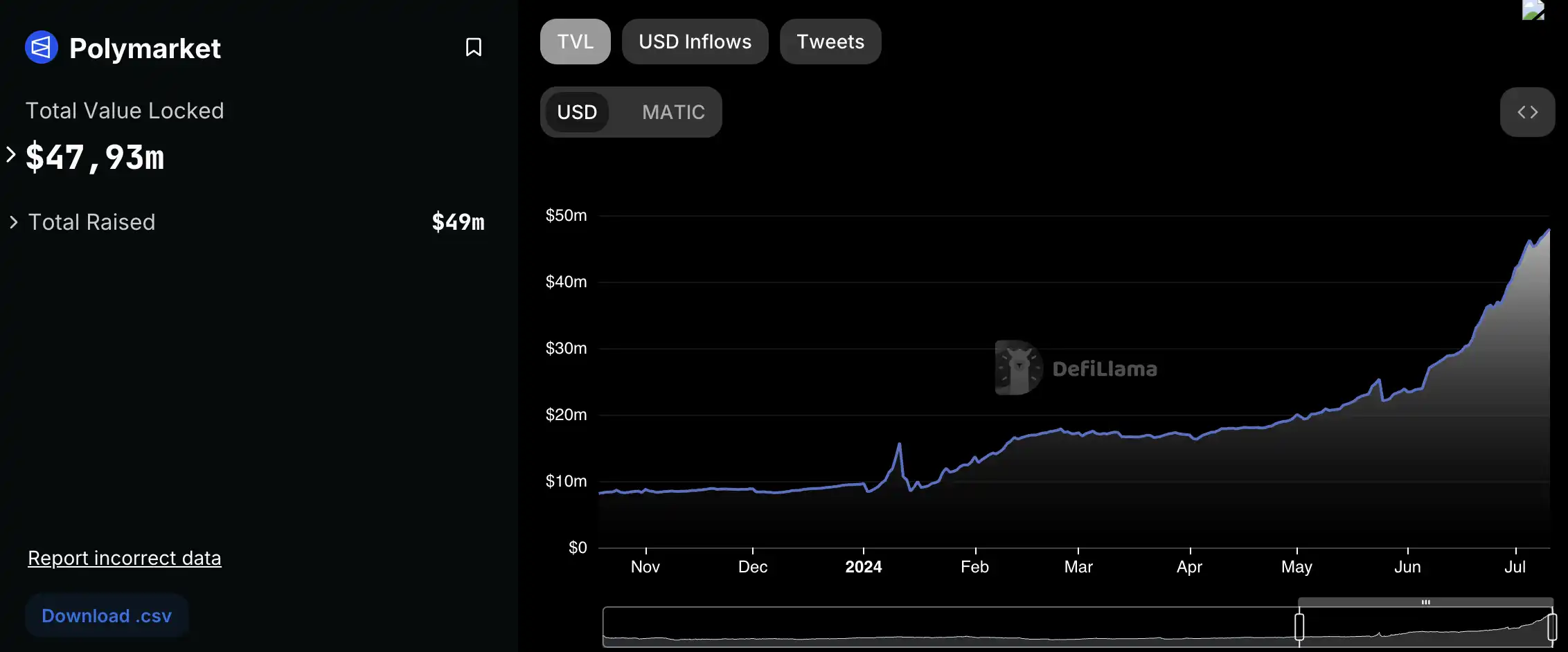
Polymarket's TVL data growth during the '24 US election period, image source: DefiLlama
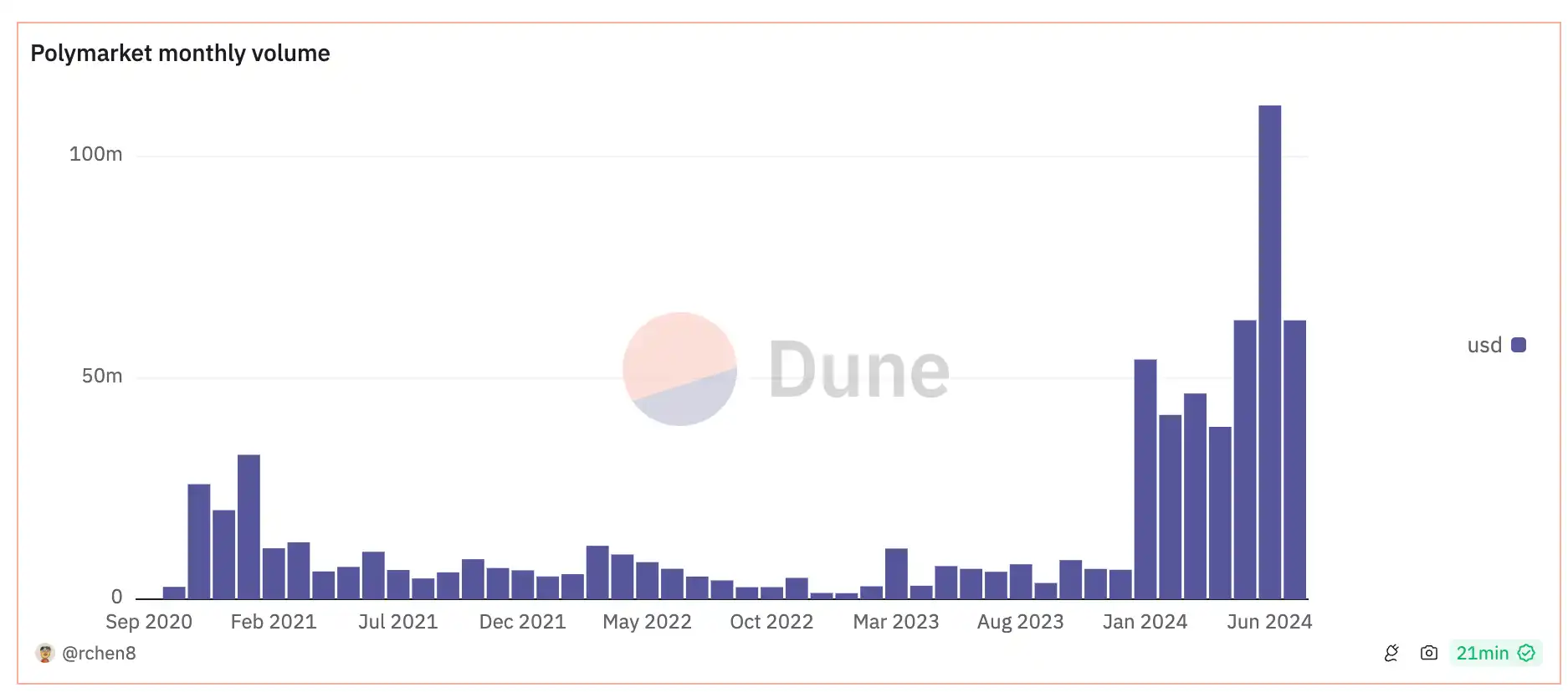
Polymarket's trading volume data growth during the '24 US election period, image source: DUNE
Meanwhile, the Trump Whale controversy erupted. A former French bank trader, identified by media under the alias Théo, bet over $45 million on a Trump victory through accounts like Fredi9999, Theo4, PrincessCaro, and Michie. The WSJ first reported the large trader's unusual activity, sparking manipulation suspicions. After an investigation, Polymarket stated it found no evidence of manipulation.
The core of the controversy wasn't just how much one person bet, but that Polymarket had finally encountered the inevitable problem following its success: if a prediction market begins to influence public narrative, is it still merely reflecting information, or is it also creating information?
On November 7, Coplan appeared on CNBC's Squawk Box, completing his first-ever television interview. Shortly after, he received a call from a senior figure at Mar-a-Lago. In a Fortune interview, he said: "I've learned that anything is possible. Turning dreams into reality has never felt more tangible, and luckily I'm a dreamer. The world is shaped and changed by optimists."
This sounded like a victor's declaration. The problem is, Polymarket's story has never been a simple victory narrative. Every time it proves itself more useful, it also pushes itself into a more dangerous position.
Eight days later, danger knocked on the door.
FBI Breaks Down the Door
On November 13, 2024, at 6 a.m., New York had not truly woken up. Coplan, who had been explaining prediction markets in front of television cameras just days earlier, was jolted awake by a loud crash. According to his later recollection in a CBS 60 Minutes interview, FBI agents used a battering ram. The door was smashed open, agents entered the apartment, and his phone and electronic devices were seized.
There was no arrest, no indictment, and no public explanation of the specific reason for the investigation.
From $3.6 billion in trading volume on election night, to the call from Mar-a-Lago, to the FBI's battering ram, only eight days had passed. A 26-year-old founder had just stood at the center of the global political narrative, and the next moment he was standing barefoot in his own home, watching federal agents take his devices. For Coplan, this wasn't just ordinary legal risk, but a deeper uncertainty: he didn't know what the investigation specifically targeted, whether he was the subject or a person of interest, or whether the mainstream recognition his company had just gained would immediately turn into new evidence of wrongdoing.
Hours later, he logged onto X with a new phone and posted: "new phone, who dis?"
This post has been repeatedly cited because it almost perfectly captures the posture of Coplan and Polymarket: no explanation, no backing down, responding to the federal government's battering ram with a flippant piece of internet slang. It reads like a joke, and also like an act of defiance.
Later, he posted a more serious message: "It's discouraging that the current administration would seek a last-ditch effort to go after companies they deem to be associated with political opponents. Polymarket has provided value to tens of millions of people this election cycle, while causing harm to nobody."
A Polymarket spokesperson defined the incident even more directly: "This is obvious political retribution by the outgoing administration." Elon Musk commented on X: "This seems messed up."
But on the other side, critics saw a different set of problems. Polymarket had committed to blocking U.S. users as early as 2022 due to CFTC penalties, yet now it was handling billions of dollars in trading volume during the U.S. election and deeply influencing American political narratives. Even if the platform claims U.S. users cannot trade, regulators have reason to ask: Are these geoblocks truly effective? Are U.S. users still accessing the platform through various means? Has Polymarket violated the 2022 settlement arrangement?
The FBI raid brought all these contradictions to the surface simultaneously. Polymarket can say it is an information market, that it has harmed no one, that it simply allows the truth to emerge faster. But in the eyes of regulators, it may still be an event contract market not permitted to enter the U.S. The more successful it becomes, the harder it is to keep hiding inside the shell of a "niche crypto product."
Three weeks later, Coplan appeared on stage at the New York Times DealBook Summit. The venue was Jazz at Lincoln Center, in Midtown Manhattan—a place far from the bathroom office, yet close to Wall Street and the media center. Seated in the audience were Wall Street fund managers, Silicon Valley tech executives, and political commentators. The lights, cameras, name badges, security, and media section all belonged to the mainstream world.
For a founder whose home had just been searched by the FBI, whose phone had been confiscated, and who still faced a pending federal investigation, this was not an obvious choice. The safer path would have been to keep a low profile, stay silent, and let the lawyers handle everything. Coplan chose the opposite direction. He walked into the center of the spotlight and continued discussing the future of prediction markets.
Meanwhile, the walls were also getting higher. In late 2024, French regulators began investigating whether Polymarket had violated regulatory rules, and the platform subsequently implemented a geoblock for France. Entering early 2025, Singapore, Poland, Belgium, and others also successively added Polymarket to lists of illegal gambling or unauthorized platforms.
Viewed individually, the impact of these bans on trading volume might be limited. But layered on top of the FBI search and the DOJ/CFTC investigations, they sent the same signal: the gray zone is narrowing. No regulatory framework in any country has a dedicated slot ready for "prediction markets."
From late 2024 to early 2025, the choice for Coplan and his team had become clear. There was no point in continuing to take detours. The real way out was not to evade regulation, but to walk into it. Not to wait outside the U.S. gates for clearance, but to buy a ticket to enter the United States.
Coming Home
Forging Ties with the Trump Family
In mid-July 2025, the sword hanging over Polymarket's head finally fell.
The U.S. DOJ and CFTC concluded their investigation into Polymarket without filing any charges, pushing aside the legal shadow of the past three years in one stroke. Many say the reason was that Polymarket had forged ties with the Trump family.
Polymarket also began to have the opportunity to execute its real expansion plans.
In July 2025, Polymarket acquired QCEX for $112 million. What was acquired was not just a name, but a complete entry point within the U.S. regulatory framework: the CFTC-registered derivatives exchange QCX LLC, and its clearing house QC Clearing LLC. QCX would later operate under the name "Polymarket US."
This step was critical because Polymarket did not choose to apply for a license from scratch. That path was too slow, too uncertain, and too easy to get bogged down in a protracted regulatory quagmire. It chose a more direct approach: buying an entity that already held the license.
On August 26, Donald Trump Jr. joined Polymarket's advisory board. Around the same time, 1789 Capital, which has ties to Trump, invested in Polymarket. This looked very much like a simple exchange of political connections, but also like an echo from the real world after the 2024 election.
Polymarket accurately predicted Trump's victory and was noticed by the Trump camp. By 2025, the regulatory environment, political winds, and discussions about the legalization of prediction markets began to intertwine. For supporters, this was an innovative product wrongly expelled finally getting a chance to re-enter the United States. For critics, it was a gray-area platform that leveraged a political cycle to stage a comeback, seeking a position closer to power.
Polymarket has never lacked this kind of ambiguity. It resembles both an information market and a gambling platform; both financial infrastructure and a political sentiment machine; it can be told as a victory for market freedom, or as a success of regulatory arbitrage. Trump Jr.'s addition merely pushed this ambiguity into a more conspicuous position.
In September, the CFTC issued a no-action letter to QCX, substantively clearing the way for Polymarket to operate event contracts in the U.S. through intermediary channels. Coplan praised the CFTC's "impressive work" and "record timing" on X.
If you place this statement next to that 2013 email to the SEC, there is a curious sense of symmetry. A 14-year-old boy once wrote to a regulatory agency asking if his exchange idea was legal. Twelve years later, standing behind a platform that had processed billions of dollars in trading volume, he finally secured a path into the U.S. regulatory system.
A Check from the NYSE's Parent Company
What truly made the outside world realize Polymarket's change in status was the deal on October 7, 2025.
Intercontinental Exchange announced a strategic cash investment of up to $2 billion in Polymarket. ICE is the parent company of the New York Stock Exchange, one of the world's most important exchange groups. Polymarket's valuation reached $8 billion, approximately $9 billion post-investment. ICE would also become the global distributor of Polymarket's event data, with both parties cooperating to advance tokenization.
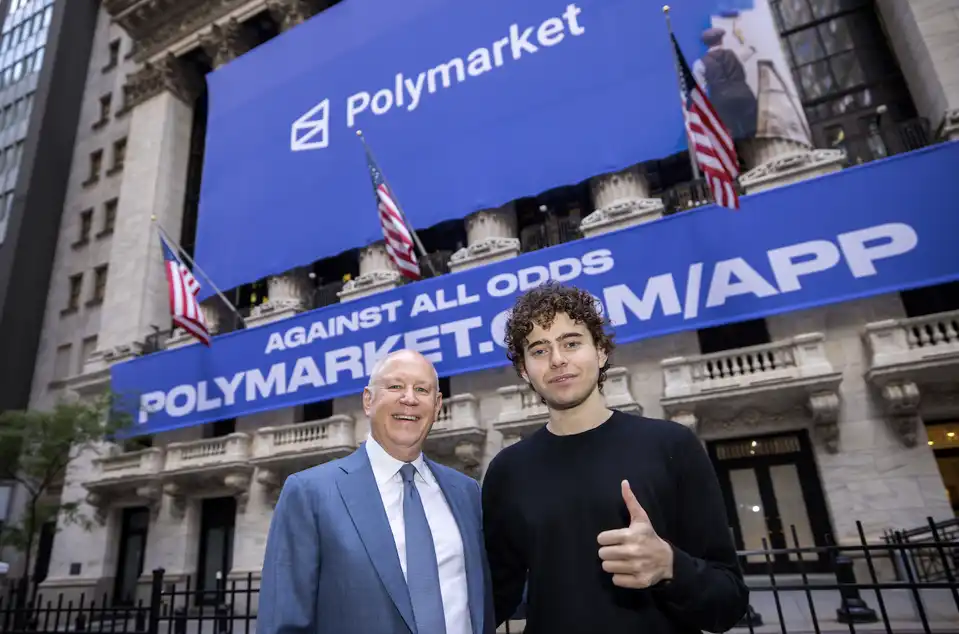
That same month, Coplan was added to the Bloomberg Billionaires Index. Forbes estimated his net worth at approximately $1 billion, based on an ownership stake of about 11%. Age 27. From a 26-year-old dropout whose home was raided by the FBI to one of the youngest self-made billionaires, less than a year had passed in between.
CBS 60 Minutes later asked him if he ever thought Polymarket could be worth this much. His answer was quintessentially Coplan: "I mean, I didn't start it to not get here, you know?"
Not humility, not surprise. It was more like saying: I was always headed here.
As the capital and regulatory narratives advanced, Polymarket began entering sports, media, and financial data systems. From October to November 2025, partnership announcements came in rapid succession. The NHL became the first professional sports league to partner with a prediction market platform. The UFC designated Polymarket as its sole official prediction market partner, with Dana White and Coplan appearing together on CNBC. Yahoo Finance made Polymarket its exclusive crypto prediction market data provider. Google Search and Google Finance began integrating Polymarket prediction data.
These partnerships seem scattered, but collectively they illustrate one thing: Polymarket is no longer just a destination; it is starting to become a data layer for others. Users may not open the Polymarket app every day, but they might see its odds in Google Search, its probabilities in Yahoo Finance, and its market signals on sports broadcast pages. The prediction market is transforming from an app users must actively visit into data content that can be embedded into other contexts.
On November 13, the one-year anniversary of the FBI raid. Coplan posted on X: "Cheers to free markets, the American dream, and $3000/hr lawyers."
One year earlier on that same day, he was woken from his bed, his phone was taken, and federal agents stood in his apartment. One year later, he is a billionaire, his company just received a $2 billion strategic investment from ICE, and the path back to the United States is about to be formally opened.
"Free markets," "American dream," "$3000/hr lawyers." Free markets are the ideal Polymarket tells the world; the American dream is the story it tells itself; and the three-thousand-dollar-an-hour lawyer fees are the cost that ideals and stories must pay in the reality of America.
On November 25, the CFTC issued an amended Order of Designation, formally approving Polymarket to become a regulated Designated Contract Market through QCX. U.S. users could trade through FCMs and traditional brokerage intermediary channels. Polymarket entered the same regulatory framework as CME and ICE.
In January 2022, the CFTC penalized Polymarket, saying it could not offer event contracts in that manner. In November 2025, the CFTC, through a different legal entity and regulatory path, allowed Polymarket to return to the U.S. as a regulated market. The door that was shut was not broken down; instead, the lock was replaced. Coplan did not circumvent the rules; he bought the entry point within the rules, and then let the regulator open the door.
In December, Polymarket US launched on a small scale, ending a nearly three-year absence from the U.S. market since the 2022 penalty. This "homecoming" was not romantic. No product button could erase the gray zone of the past three years, nor could a single approval make all the controversies disappear. But it accomplished one very clear action: the platform that was expelled from the U.S. returned along a regulatory path.
On December 1, Anderson Cooper's lengthy 60 Minutes interview aired. Coplan sat within America's most traditional TV news format, explaining to the broadest possible audience what exactly Polymarket is.
He said: "Polymarket is the most accurate thing we have as mankind right now."
He also said: "People rely on Polymarket because we provide clarity where there is confusion and accountability where there is ambiguity."
Clarity where there is confusion, accountability where there is ambiguity. For a product long accused of being a gambling platform, this was a highly ambitious redefinition.
On December 11, Coplan was named to CoinDesk's "Most Influential 2025." By this moment, Polymarket's comeback was complete: the investigation concluded, the license entry point purchased, CFTC clearance granted, ICE investment secured, mainstream media endorsement received, and the U.S. market reopened.
If the story stopped here, it would read like a standard victorious ending. But Polymarket's new normal is not tranquility; it is an even larger battlefield.
Polymarket's 6th Year
On January 7, 2026, the Dow Jones/WSJ data distribution agreement was finalized, bringing Polymarket's prediction data into the Wall Street Journal's content ecosystem. This move was not as sensational as the ICE investment, but its significance was considerable: the prices of prediction markets began entering the production workflow of the news industry.
In the past, news reported on events, and markets traded on events; now, market prices themselves become part of the news. When a journalist writes about an election, a rate cut, or a sporting event, Polymarket's probabilities can be cited just like polls, odds, or futures prices. It transformed from an object reported on by the media into a tool the media uses to report on the world.
A few days later, this instrumentalization entered an even more mainstream setting.
On January 11, Polymarket odds were displayed for the first time during the live broadcast of the 83rd Golden Globes. Red carpets, gowns, stars, trophies, and prediction market odds appeared in the same frame. Polymarket ultimately correctly predicted 26 out of 28 awards.
Coplan wrote on X: "The single most mainstream prediction market integration to date. A surreal moment and a highlight for all our team members' moms."
This statement was not written for regulators or investors; it sounded more like a young team suddenly discovering that something they built appeared on a TV show their parents would watch. But opposition also emerged at the same time. Critics called it "gambling meets dystopia." When everything can be predicted, traded, and placed into a live broadcast, does the world become clearer, or does it become colder?
On January 27, Polymarket became the exclusive prediction market partner for the full series of MLS events. Sports began to become a new battleground. Compared to politics, sports outcomes are more frequent, clearer, and easier to consume; compared to traditional gambling, prediction markets can package themselves as something closer to trading and information.
In February, Polymarket piloted taker fees in its sports market, initially covering NCAA and Serie A. Prior to this, fees in the crypto market had already generated approximately $1.08 million in weekly revenue. Charging fees marks a new phase: no longer just proving trading volume and information value, but beginning to systematically prove the business model.
That same month, former Fanatics CBO Ari Borod joined as President of Sports Business Development. Fanatics had previously sued to block his move, later settling out of court. This small episode is also telling: Polymarket's entry into sports is no longer just a crypto company expanding its categories, but a battle for talent and positioning against traditional sports commerce, betting companies, and media rights holders.
On February 4, Blockratize, Inc. filed trademark applications for "POLY" and "$POLY." CMO Matthew Modabber had already stated clearly: "There will be a token, there will be an airdrop."
This brings Polymarket's storyline back to its crypto origins. On one hand, it is entering the CFTC regulatory framework, partnering with ICE, and providing data to WSJ and Google; on the other, the market still expects it to issue a token, conduct an airdrop, and redistribute platform value back to crypto users. This is another tension for Polymarket: the more it moves toward Wall Street, the less it can completely sever its ties to the crypto community. Because the people who first believed in it, first used it, and first brought liquidity in were precisely those willing to bet on the world on-chain.
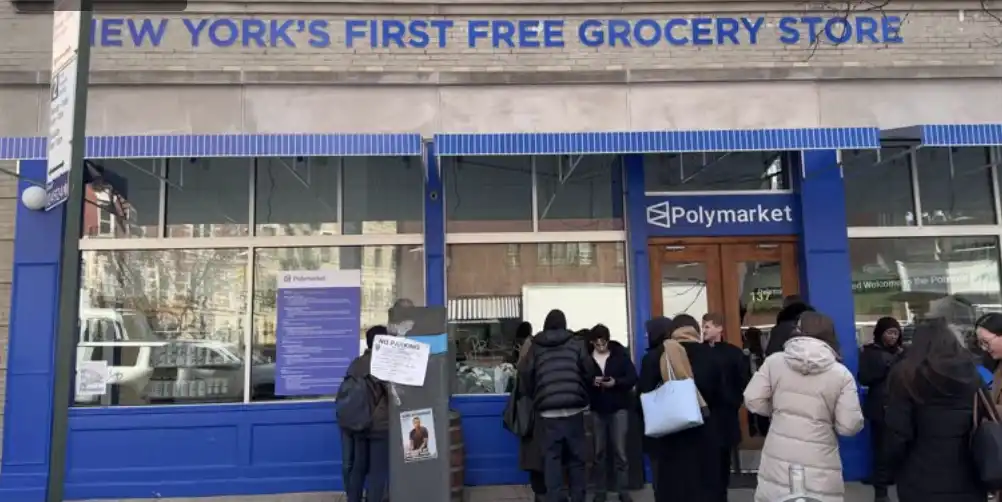
Polymarket's store in New York
In March, ICE made an additional investment of $600 million, raising the valuation to approximately $15 billion. That same month, Polymarket signed an exclusive multi-year prediction market partnership with MLB, reportedly worth up to $300 million.
On March 18, Polymarket acquired DeFi infrastructure company Brahma. Founded in 2021, Brahma had cumulatively processed over $1 billion in trading volume. Its standalone product was shut down within 30 days post-acquisition, with the team and technology fully integrated. The direction is to lower the barrier to on-chain usage: wallet creation, deposits, token swaps—the friction points that make ordinary users balk at on-chain products.
Coplan said: "Building reliable infrastructure across blockchain networks and traditional financial rails is hard—there are no shortcuts."
This statement fits Polymarket in 2026 very accurately. It is now not just a website, not just a prediction market frontend, but simultaneously straddles two sets of infrastructure: on one side, blockchain networks; on the other, traditional financial rails. One side demands openness, speed, and global liquidity; the other requires licenses, clearing, intermediaries, and compliance. The truly difficult part for Polymarket is not getting users to click yes or no, but making these two systems temporarily coexist within a single product.
On March 30, Polymarket rolled out trading fees across all categories, using an inverted parabolic fee model: Crypto peaks at 1.80%, Finance and Politics at 1.00%, Sports at 0.75%, with Makers free and receiving a 25% rebate. The market estimates annualized revenue exceeding $200 million.
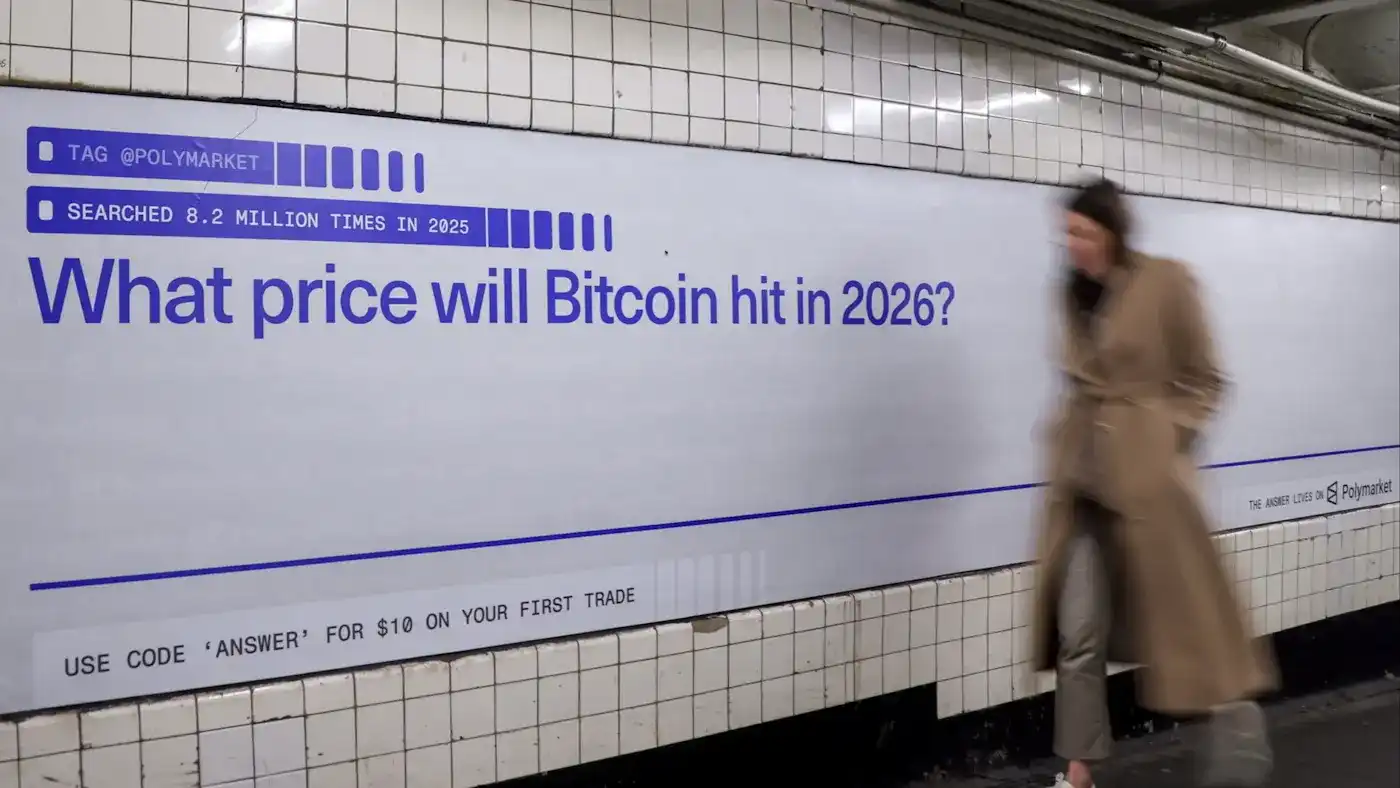
Polymarket advertisement in a New York subway station, image source Bloomberg
In June 2026, Polymarket celebrated its sixth anniversary since launch.
Six years ago, it was a small product born in a bathroom during the New York City lockdown. Six years later, it has entered Google, WSJ, sports leagues, ICE, the CFTC regulatory framework, and mainstream TV broadcasts. Cumulative trading volume, valuation, partners, regulatory status—every metric seems to prove it has moved from the fringe to the center.
But the sixth anniversary is not a fairy-tale ending.
The CFTC has proposed formally allowing sports event contracts while restricting sensitive markets such as injuries and high school sports. Bipartisan senators introduced the "Prediction Markets are Gambling Act," attempting to prohibit the CFTC from authorizing platforms to offer sports contracts. Wired reported that U.S. users still heavily use Polymarket's offshore international site. The valuation is reportedly approaching $20 billion. The $POLY token and airdrop remain anticipated, with the market predicting the probability of completing the TGE within 2026 holding steady at around 62% to 70%.
Coplan completed his return home. But it is not the America of 2020 that he returned to.
The America of 2020 was still searching for answers amid a pandemic and an election; Polymarket was a small tool that had just launched. The America of 2026 already knows this tool can influence narratives, attract capital, challenge polls, draw in regulators, and enter sports leagues and mainstream media. The door to home has opened, but the living room is filled with regulators, investors, journalists, league executives, traders, lawyers, and critics.
So "coming home" is not the end of the story, but a change of identity. On this sixth anniversary, Polymarket has finally reached the position it most wanted to be in: the world is beginning to take information markets seriously.
But this also means the world is finally about to judge it seriously.