Author: Claude, TechFlow
TechFlow Introduction: Alex Gluchowski, founder of zkSync parent company Matter Labs, announced another round of layoffs on June 17. The company is now fully betting on a "permissioned" privacy chain called Prividium, specifically serving regulated financial institutions.
This marks the company's second round of layoffs in two years. A founder who calls himself a "freedom maximalist" has ultimately steered the project toward compliance, permissioned access, and banking. Community reactions are split, with the sharpest question being: After raising $458 million, where did the money go? The $ZK token is currently priced at around $0.019, down roughly 93% from its all-time high.

The zkSync story is heading in the opposite direction of its original promise.
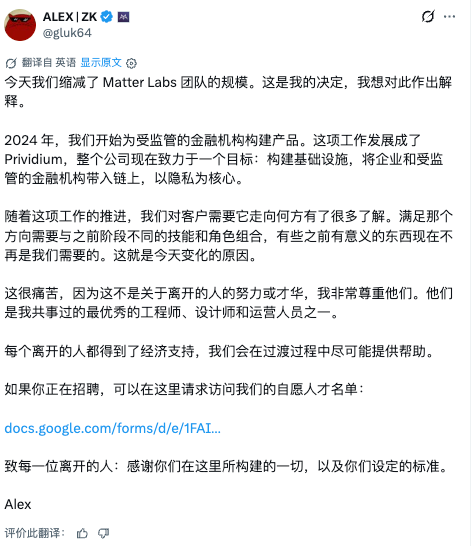
On June 17, Matter Labs founder and CEO Alex Gluchowski posted on X, announcing a reduction in the company's team size. "Today we reduced the Matter Labs team. It was my decision, and I want to explain," he wrote at the beginning of the post.
Those laid off included senior engineers, designers, and operations staff. Gluchowski called them "some of the strongest people I've ever worked with." This is Matter Labs' second round of layoffs since September 2024; the official layoff ratio was not disclosed this time.
What truly deserves attention is not how many people were laid off, but what the company has decided to become.
From "Serving Everyone" to "Serving Banks": A Complete Strategic Pivot
Gluchowski clearly explained the logic behind the layoffs in his post: Since 2024, the company has been building products for regulated financial institutions, work that later evolved into Prividium. "The entire company is now dedicated to one goal: building infrastructure that brings enterprises and regulated financial institutions on-chain, with privacy at its core."
What is Prividium?
Simply put, it is a "permissioned" blockchain, the opposite of the public, permissionless, anyone-can-use chain that zkSync has always touted. Permissioned means only approved institutions can access it; ordinary users cannot get in.
Matter Labs' official website describes Prividium as an Ethereum platform for financial institutions and fintech companies, currently running pilots with Deutsche Bank and UBS.
The irony of this pivot lies in Gluchowski himself.
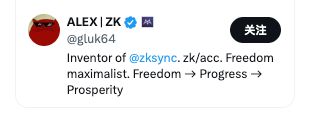
His X bio reads "Freedom maximalist," and he believes in "Freedom → Progress → Prosperity." The zkSync technology stack has long been treated as a public good by the crypto community. In 2024, Matter Labs attempted to trademark "ZK" but withdrew after collective opposition from zero-knowledge researchers, precisely because such technology should not be monopolized by any single entity.
Now, the company has proactively shifted its focus from a public chain aimed at retail users and developers to a permissioned chain serving licensed banks.
The $458 Million Question: The Community Turns Hostile
Gluchowski probably anticipated the reactions under his post.
Matter Labs has raised approximately $458 million in total funding, backed by prominent institutions like Dragonfly and Blockchain Capital. Its 2022 Series C round alone brought in $200 million. Community reactions split into two camps: one expressed anticipation for the Prividium direction, while the other directly questioned where the money went. One widely shared comment read: "Can you explain? You raised $450 million to develop a product. Where is the money? Why are you still asking for money while laying people off?"
This is not the first time Matter Labs has faced scrutiny over layoffs.
In September 2024, the company laid off 16% of its workforce, totaling 24 employees, reducing headcount to 126. At the time, officials repeatedly emphasized that the "financial situation remains healthy" and that the layoffs were to "stay lean," not due to a lack of funds. The wording of the two layoff announcements was highly similar, both citing a "mismatch between team structure and current needs."
The problem is, when a company that has raised nearly $500 million and is still fundraising conducts two rounds of layoffs in two years, the claim that it's "not about a lack of money" becomes increasingly unconvincing.
$ZK Down 93%: Token Holders Pay the Price for the Pivot
The most direct cost of the strategic shift has fallen on retail investors in the secondary market.
The $ZK token is currently priced at around $0.019, while its all-time high, set shortly after its launch in June 2024, was $0.27—a drop of roughly 93%. The token has spent the vast majority of its time since launch below its issuance price. Its current market cap is about $180 million, ranking outside the top 150 among crypto assets.
The awkwardness of the token lies in the fact that its value capture logic is disconnected from the company's new direction. Prividium serves banks, operating on an off-chain business model of "enterprise licensing fees."
A Survival Posture in the L2 Red Ocean
Zooming out, Matter Labs' pivot is also a slice of the intense competition within the entire Ethereum L2 sector.
Ethereum Layer 2 networks—scaling solutions running on top of the mainnet, pursuing faster and cheaper transactions—have seen a flood of players in recent years: Coinbase's Base, Arbitrum, Optimism, Polygon, all competing for the same developers and users. zkSync was once the most active among ZK-based L2s, but after its airdrop in June 2024, users rapidly fled. Active addresses dropped from a peak of over 200,000 in July to a 7-day average of only about 30,000 by year-end. In a highly homogenized, general-purpose track where differentiation is hard to achieve, pivoting to the "serving banks" niche—a market with higher profits and fewer competitors—is a commercially justifiable decision.
But this decision comes at a cost. It means abandoning some of the people who first believed in the "permissionless, belongs to everyone" narrative and held $ZK because of it. Matter Labs has chosen a more realistic and more profitable path, at the cost of dismantling the very banner it once erected.
Gluchowski ended his post by saying to those departing: "Thank you for everything you built here, thank you for the standards you set."
This statement also holds true for the company itself.