
Written by: KarenZ, Foresight News
If you only look at the top-tier funds, Crypto VC in the first half of 2026 is not cold.
According to Foresight News statistics, among the new Crypto VC funds announced as completed or launched in the first half of 2026, only a16z crypto and Haun Ventures reached a scale of $1 billion or more: the former launched its $2.2 billion Crypto Fund 5, and the latter completed a $1 billion new fund raise.
Among announced funds exceeding $500 million but below $1 billion, there is only Dragonfly's $650 million Fund IV. Further down are Variant's $222 million Variant 4, and ParaFi's $125 million new fund focused on stablecoins, tokenization, and institutional on-chain finance.
Almost every month, a Crypto VC secures new ammunition at the hundred-million-dollar level. The market isn't that cold.
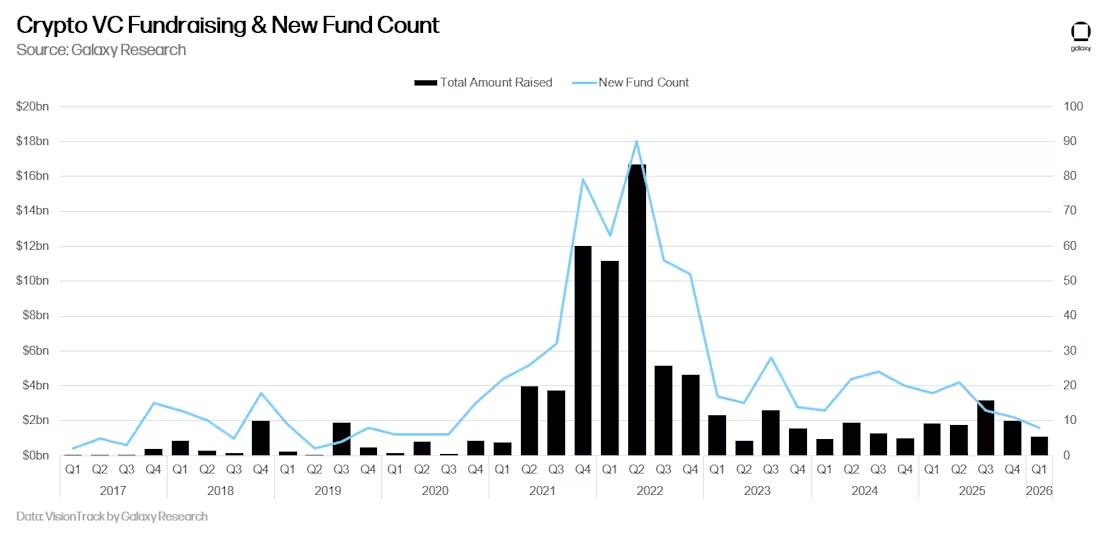
But another set of data reveals a colder side. A Galaxy Research report mentioned that only 8 new Crypto VC funds completed fundraising in Q1 2026, totaling approximately $1.1 billion, marking the lowest number of new funds in a single quarter since Q3 2020. Compared to Q1 2023, the number of new funds in Q1 2026 decreased by about 43%, total fundraising halved, the average fund size dropped by about 41%, and the median size also fell from $62.5 million to $55 million.
Source: Galaxy Research
This makes the earlier top-tier fundraising seem more significant: the market hasn't completely cooled, but the heat is mainly concentrated in a few funds. The emergence of large funds amplifies the feeling of recovery, yet the number of new funds, average size, and annualized fundraising pace all serve as reminders that the overall fundraising base of Crypto VC is already much thinner than in the previous cycle.
Combining public fundraising data with our interviews with Jocy Lin, Founding Partner of IOSG Ventures; Deng Chao, CEO of HashKey Capital; and Vivian, Founder of Starbase, a clear signal is emerging:
Crypto VC in 2026 is not a broad-based recovery, but a narrower one. The fundraising window still exists, but the door has narrowed. Those who can squeeze through are typically GPs with long-term track records, exit cases, clear strategies, and cross-cycle capabilities; projects that can secure funding are also increasingly concentrated in directions that are easier to validate and closer to real financial infrastructure, such as stablecoins, RWA, institutional financial infrastructure, and Crypto x AI.
From the changing questions of LPs, to the narrowing of sector preferences, and the restructuring of investment approaches and exit paths, Crypto VC is entering a more stringent new cycle.
LP Requirements Have Changed: AUM is No Longer Enough, DPI is the Hard Currency
From 2021 to the first half of 2022, the primary market was like a high-speed fundraising machine. Funds were raising capital, projects were financing, ecosystem funds were subsidizing, and exchanges and market makers were absorbing liquidity.
Back then, there was a default consensus in Crypto VC: as long as the industry Beta continued to expand, early-stage investments could always be picked up by the next wave of liquidity. But now, that default consensus has failed.
Jocy Lin, Founding Partner of IOSG Ventures, summarized this change as a shift from "narrative-driven" to "DPI-driven." He believes, "In the past narrative-driven cycle, the gap between top-tier and mid-tier funds was not sufficiently widened; but in the current DPI-driven environment, funds that can achieve real exits and clearly articulate their exit paths will capture more LP capital, while the remaining money will be contested among a large number of mid-tier funds."
Deng Chao emphasized, "Crypto is highly cyclical, so funds cannot rely on a single exit path; they must have cross-cycle allocation capabilities. In terms of fund allocation, HashKey Capital places more emphasis on portfolio structure: which are long-term infrastructure plays, which are cash-flow-generating projects, which are high-volatility but high-upside early-stage projects, and which can enhance liquidity through secondary market or liquid strategies."
This is also why looking at AUM alone makes it difficult to judge the true state of a Crypto VC.
A Fortune magazine report in April, based on SEC filings, provided a detail: during the 2025 market downturn, the assets under management of top institutions like Paradigm, Pantera, a16z crypto, and Multicoin were all affected. The total AUM of a16z crypto's four funds fell nearly 40% to $9.5 billion between 2024 and 2025, partly because its first three funds began distributing capital to LPs.
It is worth mentioning that Fortune magazine, citing data from Newcomer, reported that the net DPI (ratio of distributed capital to paid-in capital) of a16z's first crypto fund reached 5.4. Pantera also distributed capital to LPs in 2025 due to the IPOs of five portfolio companies, including Circle and BitGo. Multicoin was more affected by market cycles, with its AUM halving to nearly $2.7 billion between 2024 and 2025. Haun Ventures was one of the few top-tier institutions with AUM growth, increasing over 30% year-over-year to nearly $2.5 billion.
These details collectively point to a change: the narrative of scale in Crypto VC is giving way to distribution capability. What LPs really need to see is whether a GP can turn paper gains into cash returns.
This dissatisfaction has also begun to surface in more public discussions. In November 2025, Akshat, co-founder of Arthur Hayes' fund Maelstrom, mentioned on Twitter that his $100,000 investment as an LP in an early-stage token fund was worth only about $56,000 after 4 years (3% management fee + 30% performance fee); during the same period, Bitcoin doubled, and many seed-round projects saw returns of 20 to 75 times.
His conclusion was that many early-stage crypto funds have exceeded the carrying capacity of the pool of truly high-quality projects, and LPs need opportunities more suitable for large-scale allocation. Akshat took the opportunity to promote Maelstrom Equity Fund I. This fund will focus on cash-flow-positive off-chain "pick-and-shovel" businesses, providing founders with cleaner cash exits through control acquisitions, while polishing these businesses into targets that could be acquired by future new entrants like Robinhood, Charles Schwab, X, and Wealthfront.
For LPs, this type of product attempts to offer a path to allocate cash-flow assets in the crypto industry at a nine-figure scale without directly bearing token volatility.
Beyond exit assessments, LPs are also increasingly scrutinizing fund governance and risk control details.
Deng Chao told Foresight News, "LPs are no longer just asking about sectors and projects; they are more concerned about asset protection, compliance risks, exit capabilities, and real-world implementation value. What institutional LPs ultimately pay for is a set of reviewable, executable, and sustainable investment and risk control processes."
The tightening of LP standards will ultimately be reflected in the fundraising data of Crypto VCs. The Galaxy Research data mentioned earlier already indicates that both the number of new funds and total fundraising amounts are contracting, but a few top-tier GPs can still open the window.
Dragonfly is a typical example of this cross-cycle fundraising capability. In February 2026, Dragonfly Managing Partner Haseeb Qureshi announced that Fund IV had closed oversubscribed at $650 million. Bets on hot projects like Polymarket, Ethena, Rain, and Mesh became the growth cases Dragonfly used to convince LPs.
Some GPs are also trying to use the fund product itself to address LPs' new questions. Jocy Lin mentioned that IOSG plans to launch a new fund product this year, hoping to gain LP recognition through more differentiated product design and continue to output new investment cases to the market.
In other words, competition in Crypto VC is no longer just about investing in projects; it also hinges on whether the product structure can meet the requirements for liquidity, DPI, and cross-cycle allocation. A few GPs with brand recognition, performance records, and exit cases can still secure capital, while more GPs face longer fundraising cycles and stricter LP questionnaires.
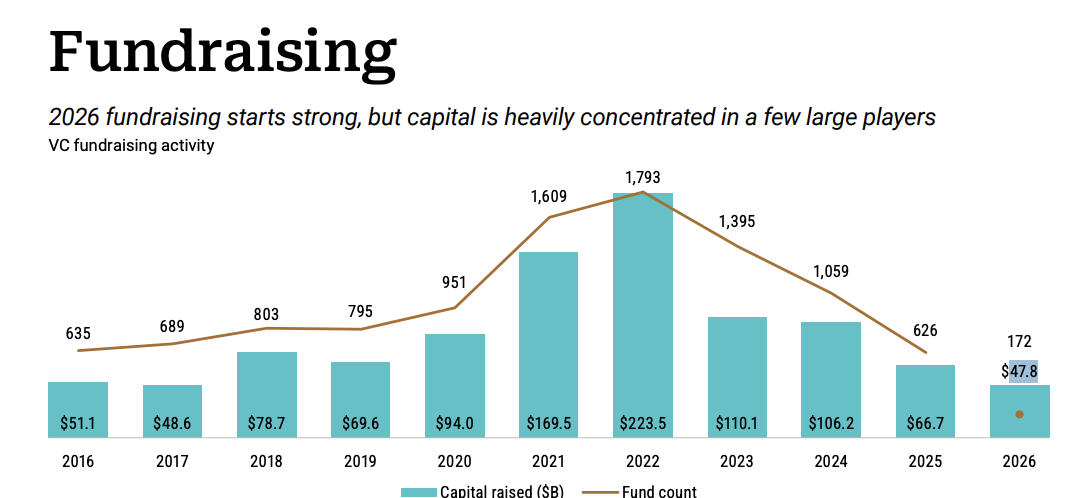
This is not a phenomenon unique to Crypto. The broader venture capital market is also concentrating towards a few large managers. The Q1 2026 Capital Markets Report jointly released by PitchBook and the National Venture Capital Association (NVCA) shows that U.S. VCs raised a total of $47.8 billion in Q1 2026.
This sounds quite strong, but capital is highly concentrated in the hands of a few large managers. Experienced managers captured 90.9% of the fundraising amount, a record high for this dataset. Meanwhile, the median VC fund size dropped from $25 million in 2025 to $15.3 million in Q1 2026. Large funds appear even larger, while the survival space for smaller funds is narrower.
Source: PitchBook and NVCA Q1 2026 Capital Markets Report
In the Asian market, this pressure is further amplified. Jocy Lin's assessment of Asian Crypto VCs is sharper. He believes that U.S. funds have a more mature LP system and could still profit from investments in major coins like Bitcoin in the last cycle; Asian funds have a much thinner LP base and limited ammunition, so they must use less money to hit more certain opportunities.
The way out for mid-tier funds has thus shifted from "keeping up with all the hot trends" to "proving unique capabilities." Starbase founder Vivian's judgment is more direct. She believes, "Pure Crypto VC has basically died out, and capital will continue to concentrate towards the top. If mid-tier institutions cannot find a vertical niche or pivot to incubation and accelerator models, it will be difficult to survive using the pure financial investment approach of the last cycle."
Sector Preferences Have Changed: New Money Bets on Crypto That Can Embed into Finance
As LPs' questions change, GPs' fundraising narratives will follow suit.
What's truly interesting this cycle is not that the keywords in fundraising materials have shifted from L1, NFT, DAO, SocialFi, and blockchain gaming to stablecoins, RWA, prediction markets, and AI; it's that Crypto VCs are beginning to admit that the growth most understandable to LPs is happening at the interface points of the financial system.
Looking at the new fund narratives from a16z crypto, ParaFi, Haun Ventures, and Dragonfly, stablecoins, tokenization, prediction markets, institutional DeFi, and agentic finance appear repeatedly.
They sound different, but the common thread is clear: they all attempt to make Crypto a part of financial processes, information pricing, or the machine economy.
These directions can be broken down into four more core lines: Crypto x AI, Stablecoins and Payments, RWA and On-chain Capital Markets, and Prediction Markets.
The first line is Crypto x AI.
AI Agents are a new variable.
Multiple VCs are placing AI agents in their focus sectors, but what they are watching is not the simple "AI + Crypto" concept.
Within IOSG's framework, the weighting and evaluation method for Crypto x AI are more specific. Jocy Lin told Foresight News that IOSG will allocate 30% of its funds to the intersection of Crypto and AI, especially decentralized data services, DePIN, data collection, and B2B scenarios. His judgment is that AI demand is strong, but if Crypto x AI projects are looking for business scenarios, they should start with B2B because revenue is easier to realize.
This means IOSG is not focused on just slapping an AI label on a project. What it truly wants to verify is whether the AI era will generate new demands for trusted data, machine payments, decentralized computing power, automated collaboration, and verifiable execution.
Haun Ventures listed the Agentic Economy as one of the three major focus areas for Fund II, believing that AI agents will complete more tasks on behalf of humans in the future: they will pay, trade, subscribe to software, purchase services, automatically collaborate across different applications, and create entirely new paradigms for coordination, trust, and value exchange.
a16z crypto also mentioned that software agents will make decisions, act, and trade on behalf of users, acquiring computing power, data, and services in the process. What blockchain can provide for AI agents are precisely wallet identities, on-chain credentials, stablecoin settlement, smart contract constraints, and verifiable execution logs.
The themes of the agentic economy and payments also appeared in the new fund themes of Dragonfly and ParaFi, indicating that more and more Crypto VCs are searching for a new financial execution layer in the AI era: who will provide agents with identity, wallets, payments, trading, data calls, and automated settlement.
It is worth mentioning that Jocy Lin stated that sectors like social, gaming, and NFTs have undergone large-scale falsification, but Jocy has not completely eliminated them. His judgment is that if these directions can be changed by AI in terms of production methods, IP gameplay, or distribution logic, new opportunities may still emerge.Additionally, IOSG will be more cautious about investing in new public chains, as the landscape of top-tier public chains is relatively stable, investment in new public chains is huge, and developer migration costs are high. Therefore, IOSG has basically stopped investing in new public chain projects.
The second line is Stablecoins and Payments.
The appeal of stablecoins comes not only from the circulation scale already achieved by USDT and USDC but also from their entry into scenarios like cross-border payments, corporate settlement, treasury management, and merchant collection. This means stablecoins are beginning to have a commercialization path as financial infrastructure.
In the official announcement for its $2.2 billion Fund 5, a16z crypto viewed stablecoins as one of the clearest use cases in this cycle, believing their usage continued to grow during the downturn and is being used for savings, cross-border transfers, and payments.
Analysis estimates from McKinsey and Artemis, annualizing activity as of December 2025, suggest that if activities primarily driven by trading, internal rebalancing, and automated contract loops are excluded, the real stablecoin payment volume is approximately $390 billion, more than doubling from 2024.
Compared to the global payments market, this volume is still very small, but the growth rate and application scenarios are clear enough.
M&A activity by traditional fintech companies in this type of infrastructure is also validating the same direction. Stripe acquired Bridge for $1.1 billion, Mastercard announced the acquisition of BVNK for up to $1.8 billion, and Kraken parent company Payward agreed to acquire Hong Kong stablecoin payment company Reap for up to $600 million.
These acquisitions indicate that stablecoin payment, settlement, and merchant network capabilities are no longer just internal opportunities for crypto-native companies but are also becoming infrastructure that traditional fintech companies are willing to buy with real money.
This change is also reflected in the sector rankings of the VCs interviewed. Jocy Lin stated that IOSG Ventures is focusing on sectors with clear interfaces to traditional finance, such as stablecoin payments, clearing and settlement, and on-chain credit. Deng Chao stated that HashKey Capital's three current main lines are trading and financial market infrastructure, stablecoin payment and clearing/settlement networks, and RWA and on-chain capital market infrastructure. Vivian also listed consumer-grade stablecoins and payment applications as one of the directions Starbase is most willing to bet on currently.
The third line is RWA and On-chain Capital Markets.
RWA is regaining attention this cycle not because "moving assets on-chain" is new, but because it is getting closer to the links traditional finance truly cares about: asset issuance, distribution, collateralization, trading, and settlement.
In its "Tokenization 2030" report released in June 2026, Citi projected that the global tokenized asset scale could reach $5.5 trillion in a base case scenario and $8 trillion in a bull case scenario by 2030.
The actions of traditional financial institutions are also making this logic more concrete. Major market infrastructure providers, including DTCC, the New York Stock Exchange, and Nasdaq, have also begun integrating tokenization into their core platforms.
For VCs, these types of projects are easier to verify than many consumer narratives from the last cycle. What the underlying asset is, who is responsible for issuance and custody, who will buy it, how cash flow is generated, how compliance status is obtained, and how secondary liquidity forms will all directly affect whether a project can be established.
Both HashKey Capital and IOSG are viewing these directions within the framework of financial industry innovation.
Deng Chao stated, "What attracts us to this direction is the combination of the regulatory window, institutional demand, and exit potential. The key to RWA is not just putting assets on-chain, but whether doing so can improve asset accessibility, liquidity, transparency, and usage efficiency."
Jocy Lin also mentioned that IOSG values directions with clear interfaces to traditional finance, such as on-chain credit (like Morpho) and RWA.
Haun Ventures' description of this direction is closer to "new assets and markets." Haun Ventures mentioned, "Stablecoins are just the beginning; tokenization is expanding to currencies, securities, derivatives, and other real-world assets. Once issued in a tokenized form, these assets become borderless, always-on, and programmable financial primitives."
The fourth line is Prediction Markets.
For Crypto VCs, the appeal of prediction markets comes not only from trading volume but also from their potential to grow into a new type of information market infrastructure.
From Haun Ventures' perspective, prediction markets can naturally extend from the logic of tokenization. Haun Ventures believes that tokenization can also create new market forms because it can form global liquidity pools without relying on individually built trading and settlement infrastructure in each region. Prediction markets are a typical example. Although today's prediction markets are mainly concentrated in sports and politics, in the future they may give rise to event risk hedging, insurance, and business outcome markets, and the resolution outcomes of these markets can directly trigger conditional, programmable capital flows."
a16z crypto researcher Scott Kominers, an economist who has long studied markets and incentive mechanisms, stated in an article published in June, "The ability of prediction markets to directly provide probability estimates is itself a 'superpower.' Its investment implication is not just 'betting on event outcomes,' but placing dispersed information, incentive mechanisms, event verification, contract settlement, and transparent auditing into the same market structure."
However, the rapid influx of capital can also drive up entry costs. Jocy Lin believes that the prediction market sector is already showing signs of capital concentration, and projects like Polymarket may face overvaluation issues.
There is a common thread among these directions: they are easier to embed into real financial processes or information pricing.
The projects Crypto VCs now favor can hardly rely mainly on grand narratives and distant token liquidity to support their valuations; they need to enter real transaction demand, institutional distribution networks, financial ledgers, or new automated processes of the AI era.
Investment Tactics Have Changed: Viewing Primary, Secondary, and Exits Together
As LP requirements tighten and VC focus sectors move closer to real financial processes, Crypto VC tactics are also shifting from "getting in" to "how to handle and exit."
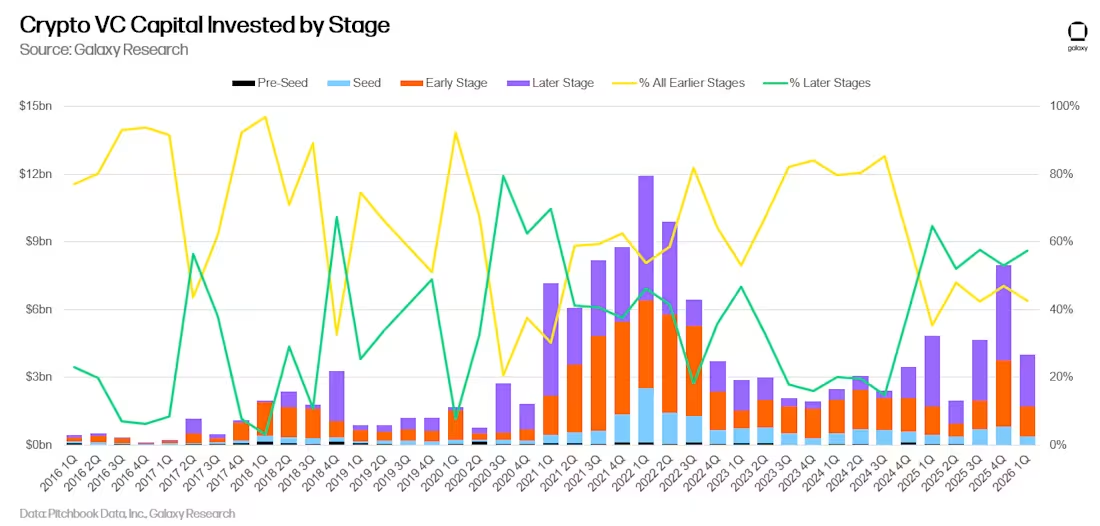
The distribution of investment stages first provides a signal. Galaxy Research mentioned in its Q1 2026 report that 57% of capital flowed to later-stage projects in Q1, with younger companies receiving about 43%; by number of investment deals, the proportion of Pre-Seed rounds dropped to 19%, while later-stage deals rose to about a quarter.
Source: Galaxy Research
This does not mean early-stage investing is unimportant. Variant still emphasizes investing at the earliest stage, Haun Ventures will also deploy in both early and later stages, and a16z crypto emphasizes more whether a project can enter real user scenarios like finance and payments.
What has really changed is that early-stage judgment must be placed on the same table with product validation, revenue validation, compliance pathways, and exit pathways.
This change also has a more micro-level market feel. On June 15, Jademont, Founding Partner and CEO of Waterdrip Capital, mentioned on X that a team seeking funding only wanted $36,000, saying this was the actual expenditure after strict calculation. Jademont believes that the industry becoming more pragmatic could actually be a bottoming signal.
In terms of specific allocation, some VCs have already begun managing primary, secondary, and OTC opportunities within the same portfolio.
Multicoin Capital has built a heavy position in the privacy coin ZEC since February this year.
IOSG's portfolio adjustment also reflects this change in tactics. Jocy Lin stated, "IOSG maintains a total investment volume of about 15 projects per year, with 30% being lead investments. Affected by the market environment, the decrease in quality primary market projects has led to a slowdown in the frequency of publicly disclosed investments, but overall activity has been maintained through Post-TGE and OTC transactions. IOSG has adjusted its investment ratio to: 50% primary market, 30% Post-TGE, and 20% OTC, to capture severely undervalued secondary market opportunities." Jocy Lin revealed that he personally contacts 3-5 offline projects per week, maintaining a high-intensity project screening rhythm throughout the year.
This ratio is more suitable as an individual institutional case, but it reflects a more general change: Crypto VCs are shifting from purely investing in primary projects to simultaneously managing primary, secondary, Post-TGE, and OTC opportunities.
Many Post-TGE projects already have cash flow and user growth, but their token value has not been fully priced by the market. These types of opportunities were easily overlooked in the last cycle of hot money. For investment teams, judging a project can no longer stop at the funding round; it must also look at its repricing opportunities in the secondary market, OTC liquidity, and token value capture.
The change at HashKey Capital emphasizes more the disciplining of the investment framework itself and the ability to allocate across cycles. Over the past year, their biggest optimization has been making the investment framework more disciplined, systematic, and verifiable. The team remains active, but the investment pace is more disciplined compared to previous years, with a greater willingness to back teams that have already proven they can do business, as such projects tend to be more resilient during cycle downturns.
HashKey Capital's current fund adopts a multi-strategy structure, combining primary market, public market, OTC, PIPE, convertible bonds, and some liquid cross-over investment opportunities.
Starbase has adjusted its strategy toward a smaller number of high-quality, deeply operated projects. Vivian mentioned that Starbase focuses on incubating no more than 3 key projects per cycle, no longer pursuing a broad-scatter investment approach. Instead, it concentrates funds and resources to support key teams in vertical tracks such as RWA, AI Agents, consumer-grade stablecoins, and payment applications.
AI is also changing the workflow of VCs themselves.Jocy Lin observes that AI is giving global capital markets a certain "Crypto-like" characteristic: information distribution is faster, ordinary investors' judgments and trading decisions are more easily amplified by AI, and capital is more prone to concentrate on a few targets with the highest certainty. For VCs, human-to-human judgment and trust remain difficult to replace, butprocess-oriented work such as data observation, statistics, backtesting, and cross-time-zone collaboration has already begun to be rewritten by AI Bots.
Changes in approach will also extend down to the due diligence level.
Crypto VC has not stopped taking risks; it's just that the budget for risk-taking has become more disciplined.
This discipline is first reflected in the changing nature of due diligence questions. HashKey Capital's due diligence has shifted from narrative coverage to hypothesis verification: the era of glancing at every new narrative is over. Projects must answer who the customer is, who pays, why it is needed now, whether there is real retention and organic demand, how value is ultimately captured, and whether the team has long-term execution and capital management capabilities.
At the project level, the granularity of verification becomes finer.
IOSG's Jocy Lin breaks down this due diligence change in even greater detail. Revenue is no longer just about the top-line figure, but must be broken down into its structure: how much comes from hardware sales, node sales, subscription fees, protocol fees, and recurring revenue, and whether ARR is sustainable. Consumer projects can no longer just report a flashy user number; more granular data such as retention rates, conversion rates, payment behavior, and retention are now entering the VC's basic checklist.
In other words, the due diligence language of Crypto VC is shifting toward unit economics, cost structure, gross margins, and long-term value capture.
Jocy Lin's reminder is more like a risk memo for entrepreneurs.He believes that for projects that survive this cycle, the key metric has already shifted from TVL or MAU to cash flow.He also emphasizes that a token is essentially a liability; avoid issuing one if possible, and delay issuance if it must be done.
According to IOSG's internal observations, in the 2024 to 2026 cycle, the median comprehensive listing cost borne by projects on top-tier exchanges is approximately $8 million, which includes structural costs such as deposits. This figure may not apply to all projects, but it reveals a problem masked by the last bull market: issuing a token does not equal an exit; often, it merely accelerates future liquidity pressure. The valuation at which a project raises funds today determines what metrics it must achieve in the next three years to sustain the next round. If it cannot sustain it, it should not raise funds.
As project screening and due diligence standards change, the post-investment value of VCs must also be reassessed.
In the past, a fund was considered valuable if it could help a project with fundraising, ecosystem business development, and exchange relationships. Now, portfolio companies need more support with regulatory communication, institutional client referrals, and Asian market expansion. Deng Chao mentioned that HashKey Capital's post-investment focus will place greater emphasis on institutional client connections, Asian market expansion, compliance resources, exchange and liquidity resources, ecosystem partnerships, follow-on financing, and brand building.
The change in exit paths is the final piece of the strategic shift.
In the past, Crypto VCs could default to tokens as the core exit channel. Now, exit paths are becoming more complex: IPOs, strategic M&A, secondary market exits, and post-TGE liquidity management are all being factored into VC investment judgments upfront.
The stablecoin payment infrastructure M&A chain mentioned earlier is precisely a signal: when a Crypto project can embed itself into real financial processes such as payments, custody, trading, brokerage, clearing, and settlement, its exit counterparties are no longer limited to exchanges and the secondary market, but could also be payment companies, exchanges, banks, brokers, custodians, or fintech platforms.
The implication for VCs is direct: if a project can be understood, integrated, and priced by traditional finance or fintech buyers, it is easier to form an exit story that LPs can understand. Tokens remain important, but they are no longer the only answer.
Why the change?
This shift is not because VCs suddenly became conservative; it is driven by four forces squeezing simultaneously.
First, the trauma from 2022 to 2023 still lingers.
The FTX, Terra, Three Arrows Capital, and a series of bankruptcy events shattered LP trust in Crypto. Many projects, after raising funds at high valuations in the last cycle, had neither revenue nor real users, and ultimately could only create paper exits for early investors by issuing tokens.
LPs are now pressing on liquidity, custody, counterparty risk, and compliance disclosures, driven by cyclical memory.
Second, AI has absorbed global venture capital's attention.
According to Crunchbase statistics, in Q1 2026, 6,000 startups globally raised approximately $300 billion in venture capital, a quarter-over-quarter increase of over 150%, with AI companies receiving about $242 billion, accounting for roughly 80%.
This shows that what competes with Crypto for LP attention is not just other Web3 narratives, but also the broader AI and later-stage tech assets.
When AI absorbs capital at such an exaggerated speed, Crypto VC can no longer compete for LP imagination with the "next-generation internet" narrative. It must prove that it still holds an irreplaceable position in the AI era, for example, in machine payments, agent identity, verifiable data, decentralized computing, compliant settlement, and on-chain financial execution layers.
Third, institutional clients are truly beginning to come on-chain.
Stablecoin payments, tokenized U.S. Treasuries, on-chain clearing and settlement, RWA perpetual contracts, prediction markets, and institutional trading infrastructure are all moving Crypto from retail speculation toward more complex financial scenarios. Institutions do not migrate processes for a beautiful narrative; they migrate only for cost, efficiency, regulatory feasibility, and new revenue. This naturally brings Crypto VC's judgment criteria closer to traditional finance.
Fourth, the U.S. policy environment has improved significantly.
Since 2025, U.S. regulatory signals have shifted from pure enforcement to rule-shaping. The U.S. SEC has provided clearer interpretations on how securities laws apply to digital assets, and discussions on the boundary between the SEC and CFTC have begun to materialize; in May 2026, the U.S. Senate Banking Committee advanced the CLARITY Act.
Regulatory uncertainty has not disappeared, but policy signals have shifted from pure enforcement to rule-shaping. For VCs, this increases the investability of projects in compliant payments, stablecoins, custody, RWA, and market structure.
These forces combined are pushing Crypto VC toward a harder evaluation framework. LPs want to see DPI and risk controls, GPs need to explain the liquidity and exit paths within their portfolios, and entrepreneurs must prove that their projects are not just waiting for the next wave of market sentiment.
In the last cycle, Crypto VC was often pricing a future that had not yet fully taken shape. By 2026, the market demands that entrepreneurs put more on the table: revenue structure, customer lists, compliance paths, token value capture, and exit plans must all withstand scrutiny.
This does not mean Crypto no longer needs imagination. On the contrary, stablecoins, RWA, prediction markets, and AI agents still require new market imagination.
The change lies in the fact that imagination must be connected with verifiable demand, cash flow, compliance paths, and value capture mechanisms.